



October 14, 2026
Have you ever asked a student to write an equation for a word problem and watched them write something that has nothing to do with the story?
A lot of kids also jump to an equation first because it’s what they’ve learned to do, whether at school or at home. Somewhere along the way, they got the message that an equation is what math looks like. Most of us got that message too.
Structures of Equality is a comprehension-first framework that helps students understand what a math story is asking. Students identify the math main idea, then draw a structure that shows the relationship in the story, with values, labels, and a representation of equality. Although equations aren’t part of that comprehension work, I know helping students write equations for word problems is still part of the job. It’s a skill students need, and sometimes it’s what some standards require.
I’ve written about how to use the structures to write equations from Compare and Repeated Equal Groups models. This post picks up after that.
So the question I want to focus on is what happens after the equation is written. How do we help students figure out whether it represents what the math story says?
Why Students Write Equations That Don’t Match the Word Problem
An equation is a symbolic representation of a statement that describes a situation. That means if a student doesn’t understand the situation, they have no way of knowing whether they’ve written the right symbolic representation. They can get an answer and still not know whether the equation matches the story.
Say a student reads this math story:
Priya had some library books checked out. She checked out 7 more on Saturday. Now she has 15 library books. How many did she start with?
They see the word “more” and write 15 + 7 = 22. They have an equation and an answer, but nothing prompts them to go back to the story and notice Priya now has 15, not 22.
This is why it matters that students draw the structure. It shows the relationship that’s happening in the story, so they have something to check their equation against. Going back to the structure lets students move between representations in the CRA framework and check an equation against something they can see.
Questions to Ask So Students Can Check Their Equation Against Their Model
When a student tells you they’re done, ask them to show you how the equation connects to their structure. “How did you get that equation?” is a good place to start, and so is “How did you know what operation to use?” Then listen for whether they point back to their drawing and the story.
- “What was the relationship in the story that told you that?” → ties back to the math main idea
- “What does this value represent?” → connects to their labels
- “Where is that number in your structure?” → connects to the value
In response to that last question, a first grader who wrote 15 + 7 = 22 points to the 7, looks at the 15, and says, “Wait, the 15 is the whole thing, the total.”
If they can’t answer, ask them to tell you the story using their structure. Retelling shows you what they understand, and it gives them a chance to catch a mismatch on their own. Then they go back to the equation and ask whether it says what the structure says.
Checking an Addition or Subtraction Equation with a Parts Equal Total Structure (First Grade)
Let’s go back to Priya and her library books. The math main idea describes parts being composed to form a total, or a total being decomposed into parts. That means Parts Equal Total (PET) is the most accurate structure to model the relationship.
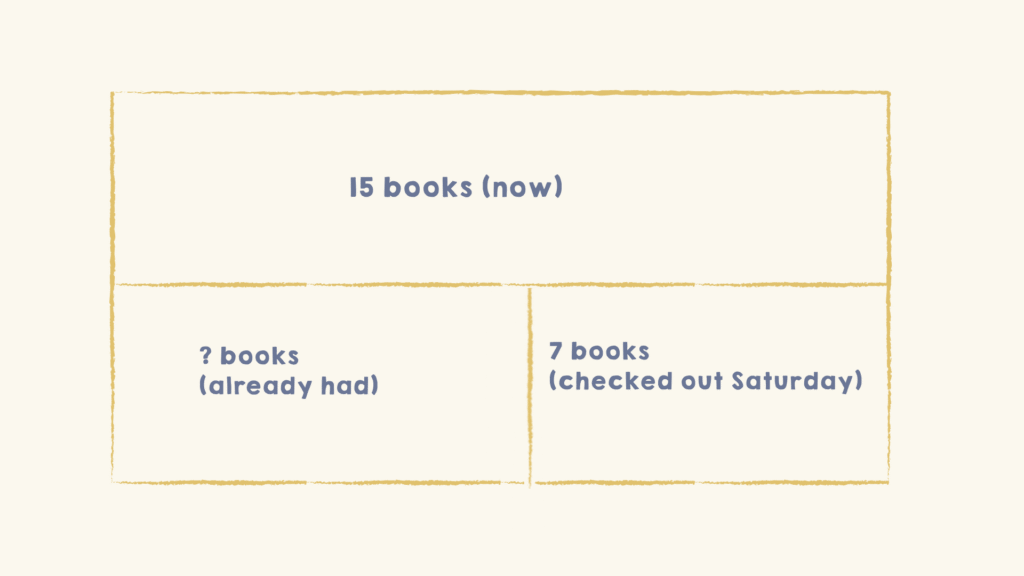
The total is 15, the books she has now. One part, or amount, is the 7 books she checked out on Saturday, and the other group is the books she already had, which is the value we don’t know yet.
Let’s go back to Priya and the student who wrote 15 + 7 = 22. You might start by asking, “On your structure, which value shows the total number of books she has now?” If they can point to the longer bar, ask them to show you that part in their equation. If they can’t say, you can walk through it together. “I notice you have a total and two parts. What’s the value of each part?”
Once students understand the values and how they relate, you can talk about how to show that relationship in symbols. Their new equation might read 7 + ? = 15 or 15 − 7 = ?. Both match the structure, which matches what’s happening in the story.
Checking a Multiplication Equation with a Multiplicative Compare Structure (4th Grade)
Now let’s look at a story about pens and markers. A pack of gel pens costs $4. A box of markers costs five times as much as the gel pens. How much does the box of markers cost? The math main idea describes comparing the cost of the pens to the cost of the markers. That means Compare is the structure that matches, and because the markers cost five times as much, we’ll actually model it with a Multiplicative Compare structure.
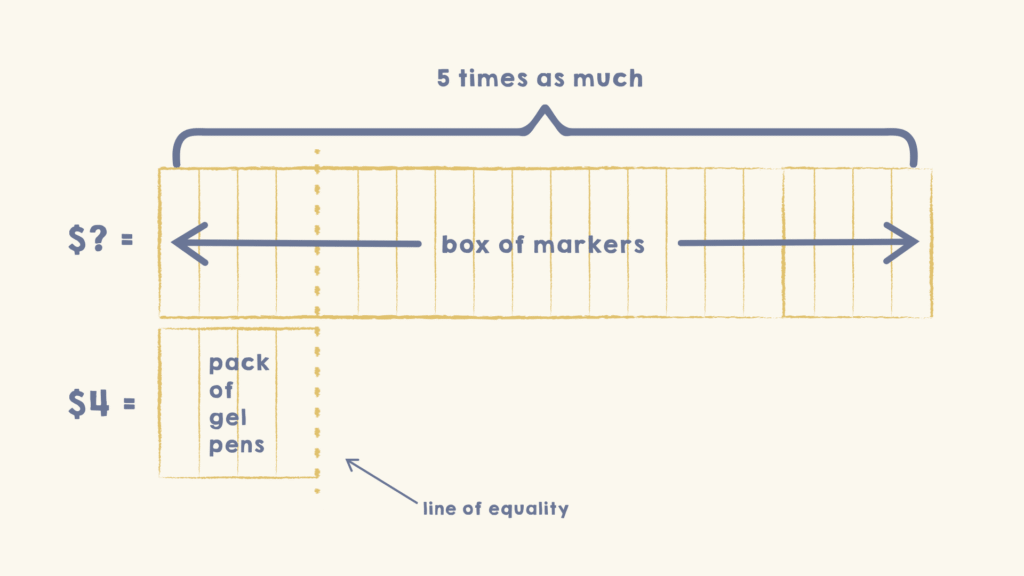
We know the bar that represents the markers needs to be longer because the story says they cost 5 times as much as the pens. So the shorter bar will represent the cost of the pens, which is $4. The dotted line of equality shows where the two bars are equal, up to the end of the pens bar.
Say you notice a student wrote 4 + 5 = 9. You might ask, “On your structure, how does the box of markers compare to the pack of gel pens?” If they can point to the bracket and tell you the markers cost five times as much, ask them to show you that in their equation. You might also ask, “If the markers cost $9, how long would that bar be next to the pens bar?” With 4 + 5, the markers cost $5 more than the pens. The structure shows five times as much. If they can’t say, you can walk through it together. “How many pen bars can fit into the marker bar?”
Once students see that the markers bar holds five $4 bars, you can talk about how to show that in symbols. Their new equation might read 4 × 5 = ? or 5 × 4 = ?. After they’ve written their updated equation, ask “What does this 4 represent? What does the 5 represent? What does the (?) represent?
Checking a Division or Multiplication Equation with a Repeated Equal Groups Structure (3rd Grade)
Let’s look at a story. The school set up 24 chairs in rows for the spring concert. Each row has 8 chairs. How many rows are there? The math main idea describes a total being decomposed into equal groups to find how many groups there are. That means Repeated Equal Groups (REG) is the structure that best represents this situation.
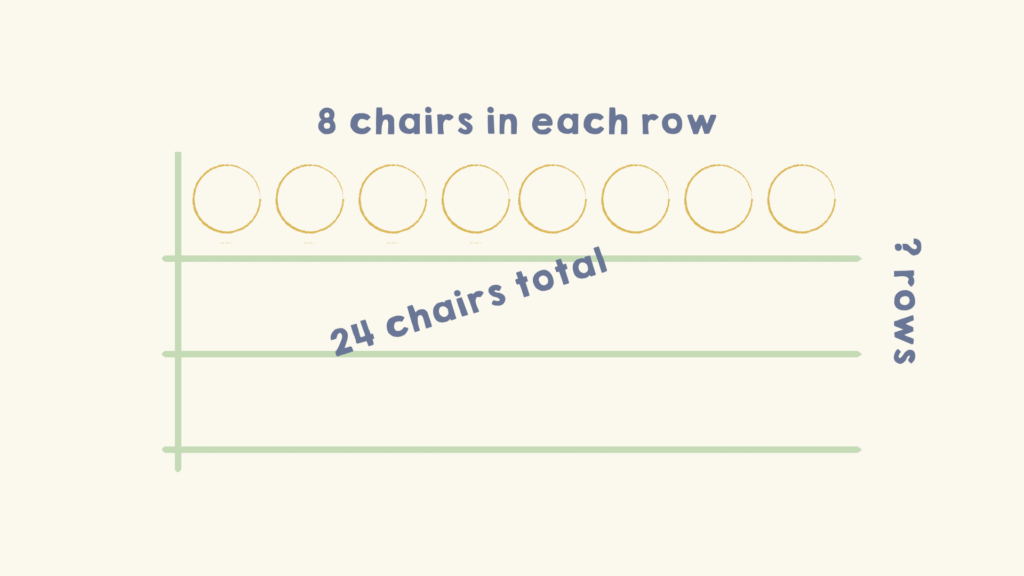
The structure shows 24 chairs total, 8 chairs in each row, and the number of rows we don’t know yet. Only the first row is drawn here. With REG, the drawing can also do some of the solving. Because we know how many chairs are in each row and we’re looking for the number of rows, students can keep adding rows of 8 until they reach 24, and the drawing gives them the answer. Depending on how familiar students are with repeated equal groups, they may need to draw all three rows. You can see this in action in my video.
Getting the answer from the drawing is a start. The next step is connecting it to an equation. Say a student drew all three rows and wrote 24 ÷ 8 = 3. That shows the solution, but it doesn’t tell you whether they understand why the equation represents the story. You might ask, “On your structure, where do you see the 24?” Then, “What does the 8 represent?” and “What does the 3 show?” If they can point to the total, the chairs in each row, and the number of rows, they’re connecting the equation to the story. If they can’t, you can walk through it together. “How many chairs are in this row? And this one? How many rows did it take to reach 24?”
Once students connect the values, you can talk about how to write the equation to match the story itself. The story gives the total and the chairs in each row and asks how many rows, so the equation that matches might read 24 ÷ 8 = ? or 8 × ? = 24. Both match the structure, which matches what’s happening in the story. The 3 they found by drawing is the solution to the question mark.
Free Structures Checklist: Have Students Check Their Own Structures
Everything above depends on a structure that’s complete and matches the story. Before students check an equation against their structure, they can check the structure itself. The Structures Checklist is free on my website. It asks students to check the box next to the structure that matches the situation in the story. Then they confirm their drawing has values, labels and descriptors, and a representation of equality. Students can use it on their own, so the checking starts with them.
When students can point to where each number in their equation lives in their structure, they understand the story behind it. Remember, students can’t compute what they don’t understand.
