


May 13, 2026
If you’ve been following this series, you’ve seen how equations can come directly from the structures students already understand.
The equality is there, but students won’t automatically see or name it without support.
In the Parts Equal Total (PET) article, we looked at how equality is visible in the length of the bars but requires explicit conversation. In the Compare article, the structure makes equality more visible through the line of equality.
Repeated Equal Groups sits closer to Parts Equal Total. When it comes time to write an equation, REG is where things get a little more complex.
What Repeated Equal Groups Shows About Equality
In an REG structure, we’re describing a situation where an equal amount appears repeatedly across groups. (The structure is named to match the exact situation occurring.)
Each group has the same value. If students don’t understand that each group represents the same quantity, the structure breaks down.
Before we ever talk about an equation, we want students to be able to describe what’s happening in the story:
- What’s being grouped?
- How are they being grouped?
- How many groups are there?
- What’s the label to describe the total amount being grouped?
Just like with PET, the equality isn’t labeled for them. It needs to be made explicit through conversation. This is how we build conceptual understanding and put meaning to the symbols students encounter when they write equations.
Repeated Equal Groups Example: Apples in Bags
Let’s look at a number story:
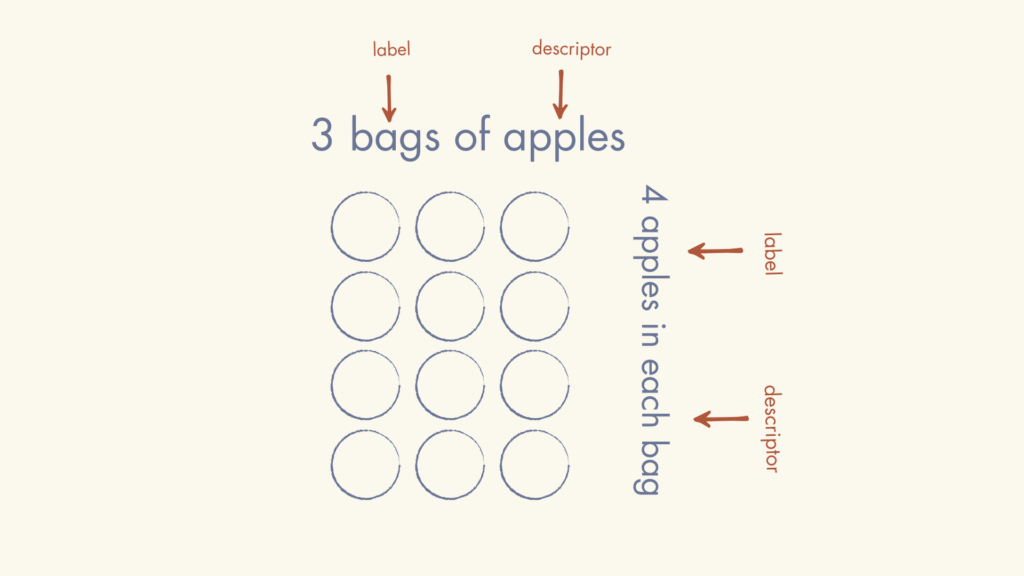
There are 3 bags of apples. Each bag has 4 apples.
How many apples are there?
The math main idea of this story describes composing equal groups to form a total, so we can represent this with a Repeated Equal Groups structure.
Before moving to an equation, we make sure students can describe what they see:
“I see 3 groups. Each group has 4 apples. All the groups are the same size.”
If they need support to articulate this idea, and especially when you first introduce the SoE framework, here’s how that might sound:
- What’s being grouped? (apples)
- How are they being grouped? (into bags)
- How many groups are there? (3)
- What’s the label to describe the total amount being grouped? (apples)
We then connect that understanding to equality.
How to Move From a Model to an Equation
When we ask students to write an equation, we’re recording what the model already shows. We need to help students make that connection so they don’t view them as two separate things.
Here’s what that might sound like in conversation.
💬 We know there are 3 groups, so I’ll start by writing that.
✏️ 3 groups
💬 Each group has 4 apples.
✏️ 3 groups of 4 apples
💬 All of the groups have the same amount, and we’re trying to find the total number of apples.
✏️ 3 groups of 4 apples equals ? apples
Before we record anything as an equation, we go back to the story. We have 3 bags. Each bag has 4 apples. We don’t know the total yet. That’s what the structure is showing us and that’s what the equation will show us too.
Now we can record it.
💬 We represent the 3 groups with the numeral 3.
✏️ 3
💬 We represent the “groups of” relationship with a multiplication symbol.
✏️ 3 ×
💬 We represent the 4 apples in each group with the numeral 4.
✏️ 3 × 4
💬 We know this value will be equal to our total, so we record that with the equal sign.
✏️ 3 × 4 =
Some students may write:
3 × 4 = ?
Others may write:
4 + 4 + 4 = ?
And that’s okay.
That tells us they’re reasoning additively and making sense of the equal groups, even if they haven’t yet shifted to multiplicative thinking. As long as their equation is connected to the story and matches the structure, it reflects understanding.
This is exactly where we want students to be before introducing multiplication as a more efficient representation. Over time, as students work with equal groups, we support them in seeing that repeated addition can be recorded in a more efficient way. That’s where multiplicative thinking begins to develop.
Notice that we don’t call this a multiplication problem (or a division problem when the total is being decomposed into equal groups). When we do that, we encourage procedural thinking over sense-making.
What Does the Multiplication Symbol Actually Mean in a Word Problem?
In the PET and Compare structures, the translation from words to symbols is fairly direct:
“and” becomes + “equals” becomes =
With Repeated Equal Groups, it’s different.
In a REG story, the multiplication symbol represents the “groups of” relationship. That’s the accurate language for this structure, and it’s what connects the symbol to the model students have drawn.
But the multiplication symbol doesn’t always mean “groups of.” Sometimes it represents “of” in a broader sense—as in, half of a fifth, or two-thirds of a whole. In those stories, there are no groups. You’re finding part of a part, or part of a whole. The symbol is the same, but the relationship it represents is different.
The model is what keeps us connected to the story, and the story is always what tells us what the symbol means.
When Should Students Write an Equation for a Word Problem?
If you’ve read the previous articles in this series, this will sound familiar. It’s worth naming this every time.
Students do not need to write an equation every time they solve a math story. Many students can show their understanding through models, reasoning, and conversation alone.
There are times when writing an equation is required: when a standard calls for it, or when an assessment asks for it. In those moments, we want students to be able to record their thinking accurately and flexibly. But writing an equation is not what determines whether a student understands.
A student who can explain the structure, describe the relationship, and connect their thinking back to the story is demonstrating deep comprehension, with or without an equation.
The goal isn’t to require equations every time. It’s to be intentional about when and why we ask for them.
Why Equations Are Hard to Teach (And What Actually Works)
Across all three structures, the pattern holds.
When students hit a wall with equations, the symbol isn’t the barrier. What’s missing is a clear picture of the relationship the equation represents
When we start with the math main idea, represent it with a structure, make equality explicit, and stay connected to the story, the equation becomes a natural extension. We’re just helping students see what’s already there.
