


May 6, 2026
If you read the last post on connecting the Parts Equal Total model to equations, this will build on that foundation. If you’re just joining us, here’s the important context: writing an equation is not the goal of Structures of Equality. The goal is understanding the story and representing the relationships within it.
But some standards require students to write an equation and some assessments ask for it. When that’s the case, the structure students already have can show them exactly where the equation comes from.
With Compare, that connection is especially clear.
What the Compare Structure Shows About Equality
In a Compare structure, two bars are aligned on one end. A line of equality marks the point up to which both bars have the same value. The longer bar extends beyond that line, and that extra section represents the difference.
The value that represents the total in the structure sits to the left of its bar.
That placement matters when students need to write an equation.
Compare Model Example: Jordan and Emma’s Marbles
Let’s talk through what this looks like in context, using this number story:
Jordan has 14 marbles. Emma has 9.
How many more marbles does Jordan have?
The math main idea of this story describes comparing Jordan’s marbles to Emma’s marbles to find out how many more Jordan has.
We can represent this with a Compare structure.
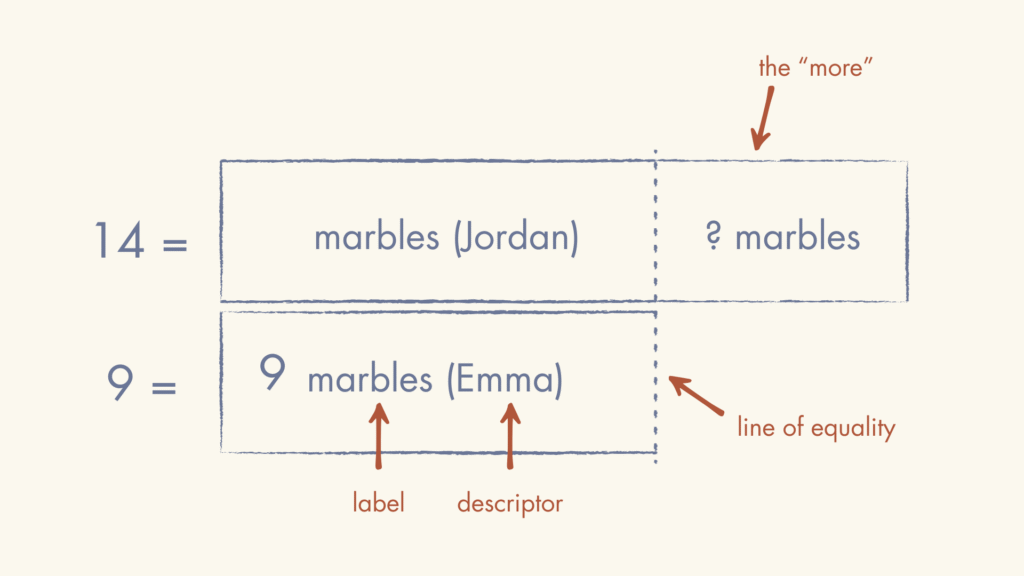
Each time students create a new representation, they connect it back to the story. That’s true here too.
Before we look at how an equation reflects this model, we make sure students can describe what they see. It might sound like this: “I can see that Jordan has more marbles than Emma. Up to the line of equality, they have the same amount. That extra part of Jordan’s bar is what we don’t know yet.”
How to Move from a Compare Structure to an Equation
If a student is required to write an equation for this story, the model they’ve already drawn has the information they need. We’re not introducing something new; we’re showing how what they already understand can be recorded in a different form.
Here’s what that might sound like in conversation.
💬 We know Jordan has 14 marbles. That value is already sitting to the left of Jordan’s bar, so I’m going to write it down first. (Starting with units keeps the meaning connected to the story.)
✏️ 14 marbles
💬 We can also see the equal sign, which means that 14 is the same value as the length of the bar.
✏️ 14 marbles equals
💬 The line of equality shows the point up to where both bars are the same. Up to that line, Jordan and Emma have an equal number of marbles.
✏️ 14 marbles equals 9 marbles
💬 If we know the value of the shorter bar, we know the value of the longer bar up to the line of equality is equal 9, so this space must also be equal to 9. But Jordan’s bar continues past the line of equality. That extra section, the “more”, is the unknown.
✏️ 14 marbles equals 9 marbles and some more marbles
💬 We can show that unknown with a question mark.
✏️ 14 marbles = 9 marbles + ? marbles
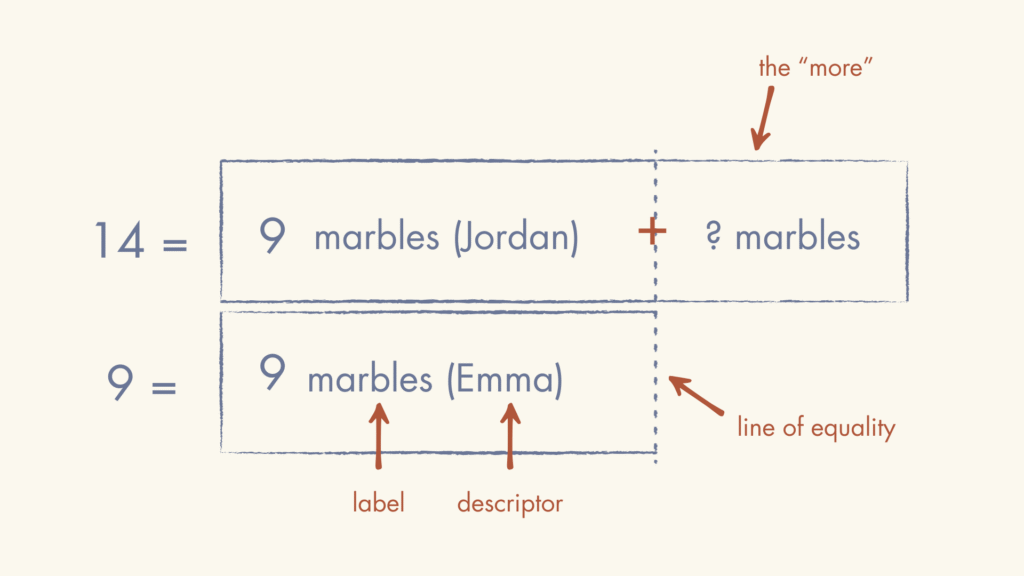
This sentence reflects the relationship already shown in the model. Once students can consistently connect it back to the story, the units can come out.
✏️ 14 = 9 + ?
The tendency for many students and teachers is to flip this equation to read 9 + ? = 14 because that’s how they’re used to seeing it.
I argue that’s exactly why we would leave it.
That discomfort is actually useful. It’s an opportunity to ask: why does this still work?
I encourage you to have a discussion that the equal sign doesn’t mean that an answer’s coming. It means “whatever is on one side has the same value as whatever is on the other side.”
When students see both forms used interchangeably, that understanding has a chance to develop.
A Common Mistake: Calling It a Subtraction Problem
When students are looking for a difference, it’s tempting to label the story a subtraction problem and move straight to an operation.
Resist that.
The Compare structure isn’t telling students to subtract. It’s showing them a relationship: what’s the same, and what’s different. The equation emerges from that understanding, not from identifying an operation first.
When we say “this is a subtraction problem,” we short-circuit the sense-making. Students stop reading the story and start looking for numbers to plug into a procedure.
Notice that we didn’t call the Jordan and Emma story a subtraction problem. We described the math main idea: comparing Jordan’s marbles to Emma’s to find out how many more Jordan has. The structure shows that relationship and then the equation reflects it.
The operation is a byproduct of understanding the story, not the starting point.
Why Compare Makes Writing Equations Easier
In a Parts Equal Total model, the representation of equality is in the bar lengths. Students need explicit conversation to recognize it.
In a Compare structure, the equality is built into the model. The line of equality is drawn right in. The values sit to the left of the bars with equal signs already attached.
When students are required to write an equation, they don’t have to construct it from nothing. The relationship is already visible in the structure they drew.
That said, we still can’t assume students see it. Even with the structure in front of them, they need language and conversation before they write anything down. Asking “what does the line of equality tell us?” or “what do we know is the same here?” keeps the focus on understanding the relationship.
What to Ask Students Before They Write an Equation
If your students have drawn a Compare model and are now being asked to write an equation, try asking:
- Can they point to the line of equality and explain what it means?
- Can they describe what’s the same and what’s different?
- Can they show you where the equation is already visible in the structure?
When the understanding is there, recording it as an equation is simply a matter of translating what the model already shows.
The Compare structure, including the line of equality, how it works across grade levels, and what student models reveal about comprehension, is explored in depth in Chapter 7 of the upcoming SoE book.
Want to be the first to know when it comes out? Get on the wait list here.
