


September 16, 2026
Why Kids Shut Down on Word Problems
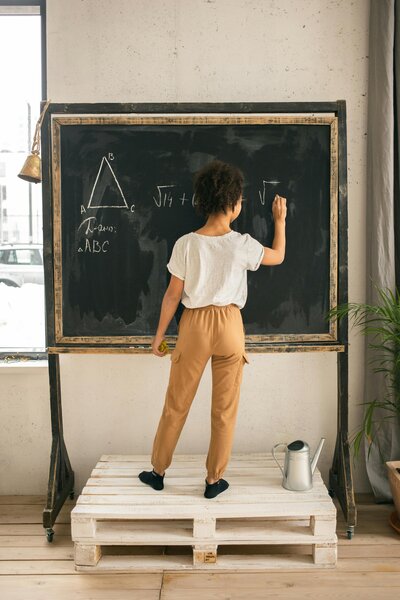
I walked into a third grade classroom as a teacher displayed a word problem with multiple math main ideas. I watched a student start it, stop, and go back to reread the story from the beginning. She got a few lines in and lost her place again. By the third time, she put her pencil down and was just staring at the page, a classic sign of when the brain hits capacity.
When there’s too much going on in a story, working memory gets overloaded fast. Kids can’t read the story, understand it, and solve it all at the same time. Something has to give. If the space fills up before a student can act on all of it, the information doesn’t stay put. Students lose track of what the story was even asking and they go back to the beginning and start over, again and again.
Working memory is the mental workspace that holds information long enough for a kid to actually use it, and in young kids, that space is strictly limited. It holds a few items at a time.
A math story asks a lot of that small space at once.
I’m sure you’ve seen it. A kid who rereads the same three lines four times, or a kid who asked you to explain the problem again, right after you just explained it, or the one who avoids the task completely by sharpening their pencil instead. It’s not that they can’t do it. It’s that we’ve asked their brain to hold onto more than it can hold.
We might think they weren’t paying attention or are “lazy”, but really their brains just hit capacity.
Structural Consistency vs. Procedural Consistency
Since working memory can only hold so much, we need to give students something to hold onto that doesn’t take up new space every time, because they’ve seen it before. That’s what structural consistency does, and it’s easy to confuse with something else: procedural consistency
Procedural consistency is a set of steps a student follows the same way every time. Draw this bar first. Circle the numbers. Underline the question. It doesn’t ask a student to understand anything. It just asks them to repeat, which means it still has to be relearned, reapplied, and re-held in working memory every single time, because nothing about it connects to something the student already understands.
Structural consistency is different. Math has structure built into it, and that structure shows up across areas of math that seem completely unrelated on the surface. A student who understands what’s happening in one place can recognize that same relationship somewhere else, even if the numbers, the context, or the grade-level content looks nothing alike.
That’s where working memory comes into play. If a kid already recognizes the relationship, there’s nothing new to figure out, they just have to spot it. A procedure just tells a kid what to do next; structure reminds them of something they already know how to do, so they can go do it again.
Where Structural Consistency Shows Up Across Math
This kind of structure isn’t unique to word problems. Once you start looking for it, it shows up everywhere in math, which is exactly why it’s worth teaching kids to recognize it.
That structure isn’t something kids figure out on their own. We have to teach it, and it starts early, with skills like subitizing.
Take numbers themselves. A number is made up of other numbers. There’s a structure that shows up again every time a student works with parts and totals. Ten can be composed by joining other numbers, like 7 and 3, or 6 and 4.
A kindergartner learning to subitize, to see five dots on a card and know it’s five without counting one by one but to see it as 3 and 2, is building the earliest version of this same idea: a number holds smaller numbers inside it. It’s the same structure a student leans on years later when they’re working with parts and totals in a math story.
Geometry works the same way. A right angle is ninety degrees. If a student sees that angle split into two parts, one labeled 27 degrees and the other labeled x, they’re looking at the exact same relationship: one part, combined with another part, equals the total. The numbers are different and the context is different–it’s not even a number story, but the structure is a part-part-whole relationship.
Fractions carry the same structure too. A whole is made up of parts, and those parts come together to form the total. Same relationship, same structure, different form.
A student who already built that parts-and-whole structure through subitizing isn’t starting over when fractions show up years later. The relationship is already familiar. All that’s new is the context, and that’s a much smaller thing to hold onto than the whole idea from scratch.
Structures show up across all areas of mathematics. This is exactly what Standard for Mathematical Practice 7 asks of students: to look for structure and use it, whether that’s noticing three and seven more is the same as seven and three more, or recognizing a part-part-whole relationship inside a geometry problem. Structures of Equality isn’t introducing a new demand on students. It’s giving them a consistent way to do something the standards already ask them to do.
Structural Consistency Inside Structures of Equality
Structures of Equality comes from this idea that there are structures built into math stories that kids can keep coming back to. These structures are exactly what helps them comprehend what they’re being asked to do, and the first one has to do with understanding the relationships occurring in the story.
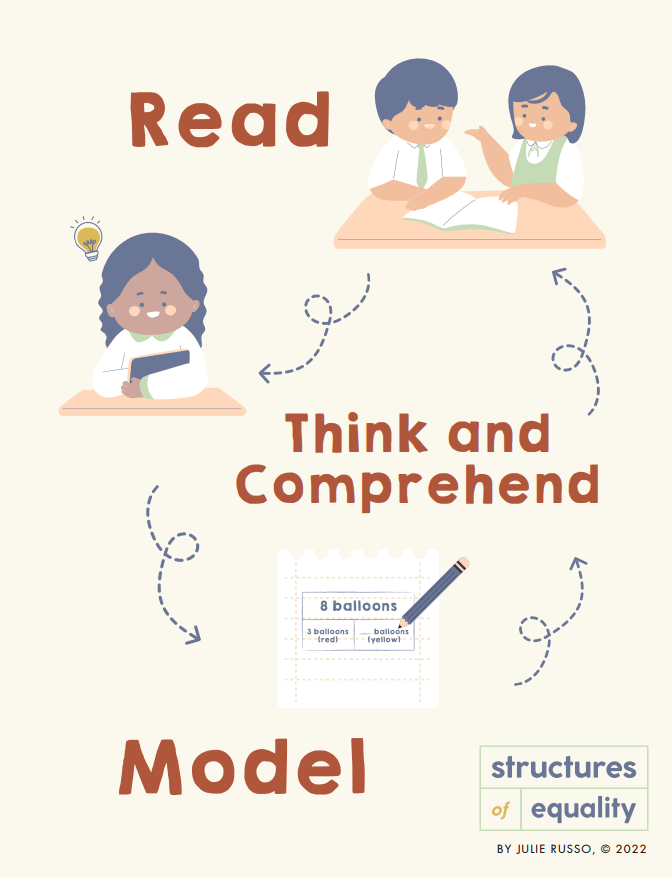
There are only three math main ideas a student will ever run into in elementary math: Parts Equal Total, Compare, or Repeated Equal Groups. Once a student understands that every math story falls into one of those three, they understand how to pair a visual model with it. Instead of learning a new way to think every time a new story shows up, they can use recognition: this matches this math main idea, I can draw it this way.
The other structure built into every model is equality. In a Compare story, that shows up as a literal line of equality, a visible point where two quantities match up.
Picture a model with six red chips and four yellow chips. Ask a student how many more red chips there are, and they’ll often say six. They can subtract just fine. What they haven’t seen yet is where the two amounts actually line up.
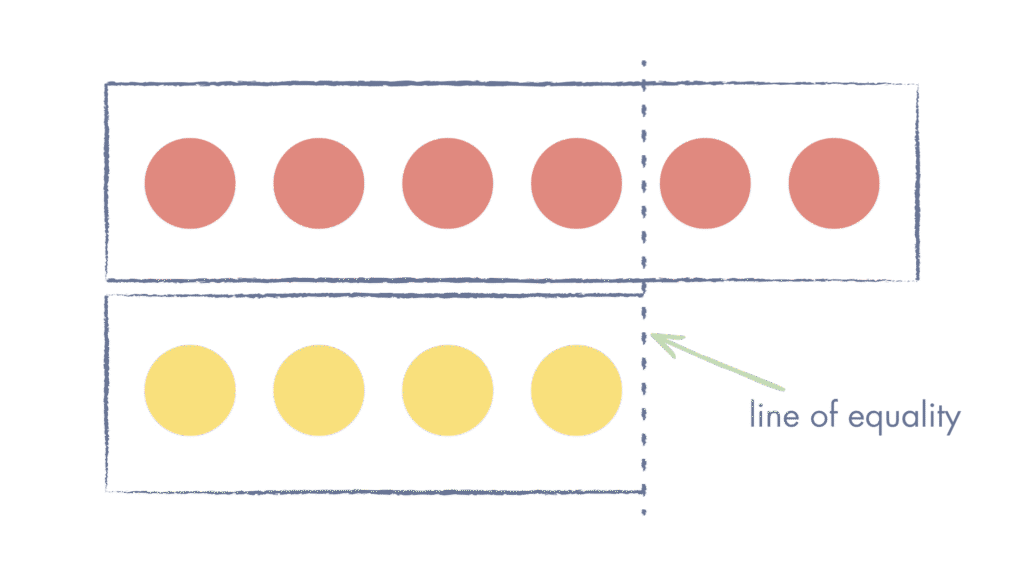
Without that, a student has to hold the whole comparison in their head and figure out where the overlap is from scratch, every single time. The line of equality does that work for them. It shows this part matches, and this part is the “more.” That’s one less thing working memory has to carry, so there’s room left for the part that actually requires thinking: what the “more” means back in the story.
That’s the real payoff for working memory. When a student has a way to model what’s happening as they’re thinking it through, they’re not spending working memory trying to figure out how to represent the story. That space is free for the harder part: working out how those relationships actually play out within the story.
Why This Frees Up Working Memory
Remember that student from the beginning, the one rereading the same three lines over and over? Here’s what’s actually going on with her. She doesn’t have anything to hold onto yet, so her brain’s trying to hold the whole story raw, all at once, and it can’t.
If you give her a structure she already knows, she has a framework to help her approach and understand the story. She reads the story first and thinks: what’s the math main idea here? She recognizes a familiar structure. Oh, this story is a total being decomposed into parts. I can draw that. I know this one.
This is also where think time comes into play. I’ve written before about giving kids the space to actually sit with a story before rushing them toward an answer, and that space is exactly what protects this from turning into a race through steps.
Once she’s got that, she can decide how to model it, and she’s still making sense of the story while she’s drawing her visual representation. And the second she can draw it, she’s done using her working memory to hold the whole story in her head. She’s comprehending that whole time too. While she reads, while she models, while she solves.
The structure gave her room for deeper thinking.
That’s the whole reason structural consistency matters. We’re not making the math easier for her. We’re just not making her carry the whole thing in her head at once while she’s trying to think.
Next time you watch a kid stall out on a story problem, ask yourself what she’s being asked to hold onto that she’s never seen before, and whether she’d have an easier time if she already knew where to put it.
