


August 13, 2026
Structures of Equality (SoE) is a comprehension-first framework. The whole point of drawing a Repeated Equal Groups (REG) model, or any SoE structure, is to represent the situation as it’s occurring in the story to ensure comprehension, not to produce an answer.
There’s a bit of an exception to this “rule” though, and it’s the kind of thing you want to watch for closely so it doesn’t turn into answer-getting. With Repeated Equal Groups, the drawing itself can sometimes solve the story while it represents it.
When Drawing the Story Also Solves It
In a previous post on writing equations from a Repeated Equal Groups model, I showed three ways a story with repeated equal groups can be missing information: the total, the group size, or the number of groups. What we didn’t spend much time on is what happens while students are drawing the model to represent this.
As I mention in Chapter 8 in Structures of Equality, “When it comes to REG, the structures can also be used as tools for solving. As we draw the models, the unknown value is revealed.”
That’s different from Parts Equal Total (PET) and Compare. With those structures, drawing shows the relationship between the values so we can see that a student understands what’s happening in the story. Solving, and writing expressions or equations when it’s needed, comes later and separately.
With REG, that separation doesn’t always hold. Drawing the representation is how the missing value gets found.
Jacob’s Cookies: When the Number of Groups is Unknown
Let’s see how this plays out in a math story.
Jacob had 24 cookies he wanted to sell at the bake sale. He packaged them in packs of 3 cookies each. How many packs will he have?
The math main idea of this story describes the total amount of cookies being decomposed into equal groups. We know the total and group size, but not the number of groups. But as we draw the packs of cookies one at a time, we can see there are 8 groups once we get to 24.
💬 I know each pack has 3 cookies. I’ll draw one pack of 3 cookies.
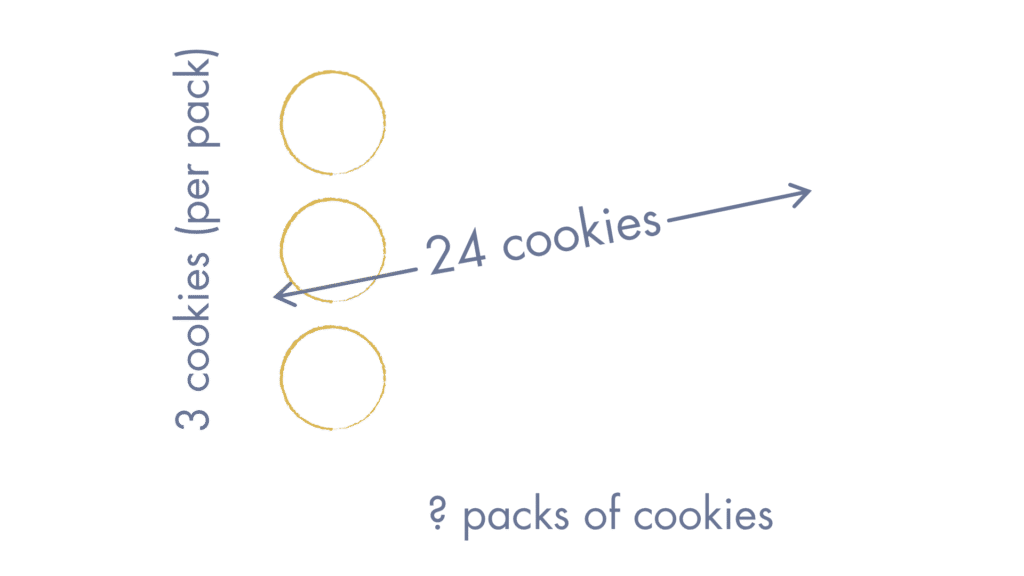
💬 That’s only 3 cookies so far. I need to get to 24, so I’ll draw another pack.
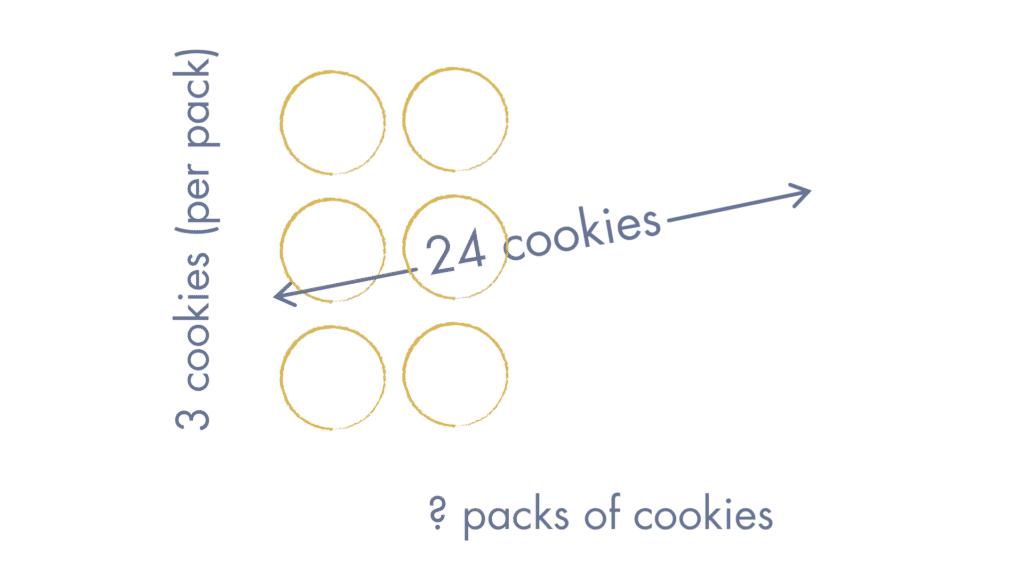
💬 I’ll keep drawing packs and tracking my total as I go so I know when to stop.
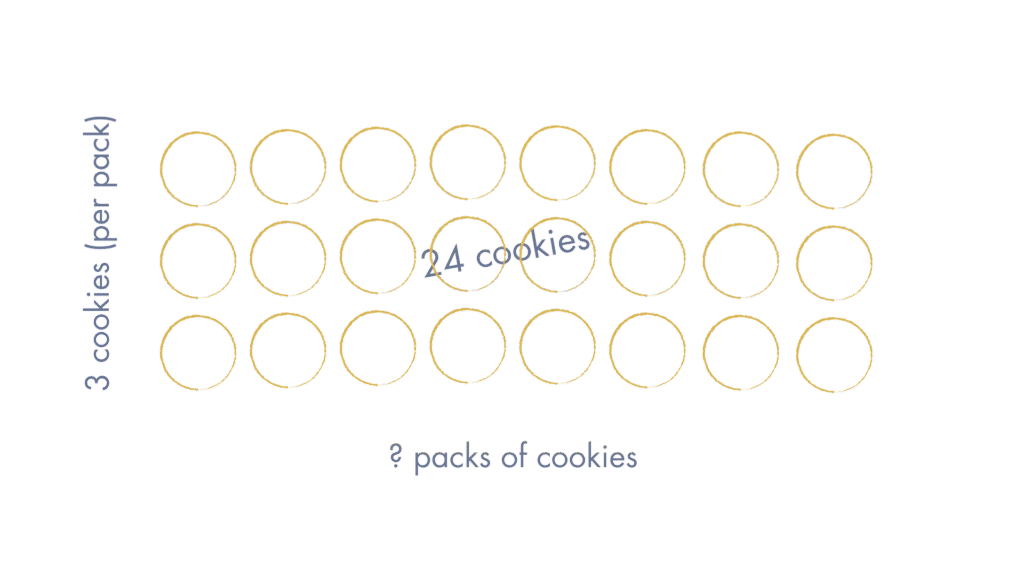
By the eighth pack, the total hits 24, and so does the answer. You can see the entire story modeled in this video.
Another Example: When Group Size is Unknown
This doesn’t just happen when the number of groups is the unknown value.
Take this story from the book: There are 12 pencils shared equally among 4 students. How many pencils does each student get?
Here the group size is unknown, not the number of groups. The drawing still works the same way. The model shows “dealing” one pencil to each of the 4 students, then another, then another, and keep dealing until all 12 are gone. By the time you’re done, you can see there are 3 pencils in each group.
Why REG Does This and PET and Compare Don’t
A Parts Equal Total bar or a Compare bar shows the relationship between the values in one drawn form. If something is unknown, it’s left as a labeled blank in the structure, and a student solves for it separately.
REG is different because it’s made of a repeating unit. Drawing it means repeating an action. That repetition is the same motion as skip counting or dealing out equally. It’s why, for some REG stories, drawing the model and finding the missing value turn out to be the same process.
This Doesn’t Undo Comprehension Before Computation
None of this turns REG into a computation shortcut. Students still need to identify the math main idea, groups being composed into a total or a total being decomposed into groups, before they start drawing. Otherwise, they may draw an accurate looking representation but not actually understand what’s happening in the story.
That’s why retelling still matters here as much as it does anywhere else in SoE. Ask a student to explain their REG structure back to you:
- What does this one circle represent?
- What does this row or column represent?
- How many of the grouped unit do we have?
A student who can narrate it understood the story.
Back to Writing the Equation
This connects directly to where the equations article left off. Once students have drawn their way to Jacob’s 8 packs, the equation is a record of what they just did. Some students will write 3 × ? = 24. Others will write 3 + 3 + 3 + 3 + 3 + 3 + 3 + 3 = 24. Others might write 24 3 = ?. These all show that students understand the relationship occurring between the values.
That range is exactly what we want to see. A student who’s still reasoning additively and a student ready to divide are entering the same story from different places, and the structure gave each of them a way in.
That’s the kind of flexible thinking SoE is built to support: not one correct path to an equation or answer, but multiple entry points into understanding the relationship. Research on the development of mathematical reasoning describes this same shift, from additive to multiplicative thinking, as something that happens gradually rather than all at once, which is exactly why a student who’s still counting up deserves the same credit as one who divides right away.
Students Can’t Compute What They Don’t Understand
That’s still true, even in the one structure that lets students solve while they draw. REG doesn’t work as a shortcut for a student who doesn’t understand equal groups. It works because drawing the representation and solving the story turn out to be the same motion, for a student who understands what they’re drawing.
If you want the full breakdown of REG across the grades, including the CRA progression, common misconceptions, and how to handle stories with more than one math main idea, it’s all in Chapter 8 of Structures of Equality: Putting Comprehension First: A Framework for Teaching Word Problems.
