



July 9, 2026
For a hundred years, we’ve taught math like fast and smart are the same thing. They’re not. A student who takes twelve seconds to think through a comparison isn’t behind. He’s working. And what happens in those twelve seconds, whether we protect them or rush past them, tells him something about whether that work is worth doing.
Why the Pause Matters More Than What You Say
A few years back, I shared a video with a colleague, Valerie Faulkner. It was one of my early ones, filmed with third and fourth graders. Valerie watched it and pointed out the wait time she noticed I provided for students. She said something that stayed with me: If a teacher gives a student time to think, that tells the student thinking time is important.
You don’t have to say a word about how much you value deep thinking; the pause says it for you. And the reverse is true too. When you rush past a student before he’s finished reasoning, you’ve told him something just as clearly.
A Simple Way to Give Students Thinking Time
Here’s one way to phrase it in your own classroom. Tell the class, “I’m going to ask a question and I don’t want anyone to talk. Don’t raise your hand. Don’t talk. I just want you to think about the question. I’m going to give you some quiet time.” Then wait, then ask the question again.
It sounds small, but it’s not. It’s a classroom management shift that takes real self-discipline. Kids are trained to blurt. Somebody always knows, or thinks they know, and their hand is up before the question finishes leaving your mouth. Protecting quiet thinking time means you have to be willing to sit in a silence that a room full of seven-year-olds is dying to fill.
Watch It in Action: A Real Classroom Example
I modeled a lesson comparing quantities of cheese and crackers using sentence strips. The link to the full version is available in my book. There’s a 30 second clip below, but before you press play, here’s what to pay attention to.
Watch for the first question and notice what I ask. Then, watch for what happens when a second student tries to jump in before the first one is ready.
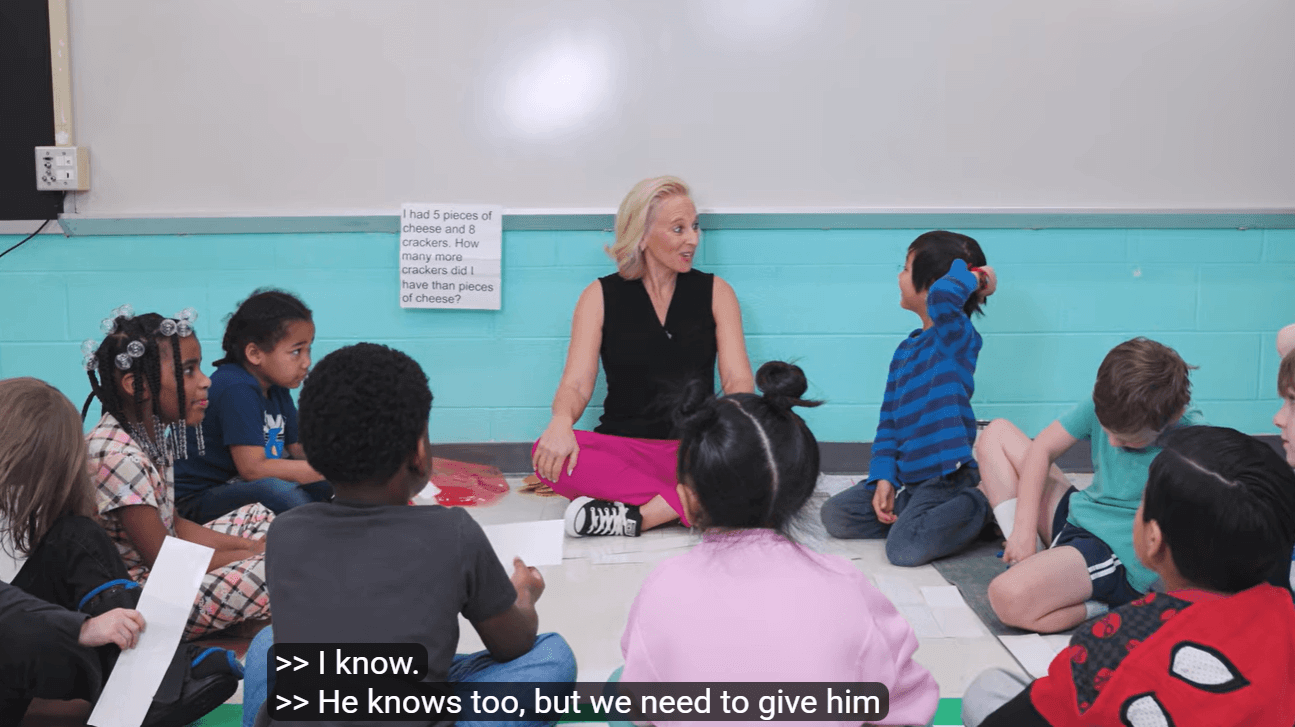
You probably noticed that at eight seconds in, he’s still thinking. At twelve seconds, another student jumps in, sure he’s got it. I stop him. “He does too, but we need to give him some thinking time.” I ask the first student the same question again.
This is the moment that matters most in the whole clip.
If I’d let that second student answer, the first kid doesn’t get to finish the reasoning he was already building. He learns that his job in math class is to be fast, not to make sense of anything, and that if he’s not fast enough, somebody else gets to finish for him.
Do that enough times and a kid stops bothering to process at all. Why work through a comparison if the answer’s just going to get taken out from under you.
It’s not only him learning that lesson. Every other kid in that room is watching too, learning that the reward goes to whoever blurts first, not whoever thinks it through.
That’s not what happened. I held the line. At nineteen seconds, he starts building his response. “Because that’s longer than the other crackers.” Then, “And this is shorter than this.” Then he connects it to the numbers. “Five is shorter than eight.”
He gets there in layers. That’s not a guess that happened to land right. That’s a kid narrating his own thinking, out loud, in front of the whole class, because nobody rescued him.
A question to sit with: When a student in your room starts to answer before another student is ready, what do you usually do? What would it take to do what happens in this clip instead?
What the Research Says About Think Time
Researchers Wang, Fuchs, and Fuchs looked closely at what solving a word problem actually requires of a student’s brain. What they found backs up exactly what you just watched happen. Making sense of a math story asks a lot more of a kid than picking an operation. It asks him to track his own thinking while he reasons through the problem and holds pieces of it in his head at the same time.
That’s what was happening in those twelve seconds before the second student jumped in. That’s what was happening in the eleven seconds after I protected the space. He was doing the actual cognitive work the problem required, and he needed the room to let him do it.
What Changes When Students Get Real Thinking Time
When students get real thinking time instead of a rush to the answer, the classroom starts to look different.
They start noticing their own thinking, not just chasing the right response. I’ll say things like, “That’s interesting what your brain just did there. My brain didn’t think that way.” That’s metacognition in language a kid can actually use. It teaches him to pay attention to how he got somewhere, not just whether he got there.
Turn and talk is an effective tool here too. It lowers the risk. A kid who won’t raise his hand in front of the whole class will often talk it through with a partner, and the thinking develops in the telling.
Also, the pressure changes. When speed isn’t the currency, being wrong stops being the scary part. Kids start showing partial thinking instead of hiding it, because partial thinking is allowed, and encouraged, to exist out loud.
Why Harder Math Questions Need More Think Time
“What’s the math main idea?” is a harder question than “what’s four plus three?” A kid can’t blurt seven at it. It asks him to hold the whole story in his head, find the relationship inside it, and put language to something he hasn’t been asked to name before.
That’s exactly what was happening with the cheese and crackers. He wasn’t slow. He was doing something hard, and he needed the room to let him finish it. The harder the thinking we’re asking for, the less we can afford to rush past the pause where it actually happens.
