



June 3, 2026
Some students make it all the way to third grade math (and beyond) looking like they’ve got it. They answer quickly and accurately. And then…
multiplication shows up and everything falls apart.
Teachers are baffled, the student is frustrated, and everyone starts looking for a third-grade solution to what is actually a first-grade problem.
This is what happens when we confuse fast with fluent.
We live in a culture that equates the first hand up with the smartest kid. We reward speed and celebrate correct answers without asking how a student got there. Parents do it. Society does it. Without realizing it, we brought that into our classrooms.
And it’s only gotten worse. We have the answers to everything at our fingertips. Have a question? Ask Siri. I catch myself doing it too, reaching for my phone before I’ve even given myself ten seconds to think. We’ve stopped tolerating the discomfort of not knowing. That muscle for sitting with a hard question and working through it is getting weaker everywhere. And kids are bringing that same instinct into math. Why think it through when someone can just tell me what to do with these numbers?
We’ve also built a mentality that math and reading are separate subjects entirely. And sometimes that thinking leads somewhere we never intended. A teacher sees that math is the one place a student shines, and naturally wants to protect that. So the numbers stay in isolation and we don’t burden them with having to read word problems. It comes from a good place, but what we’re actually doing is narrowing what that student believes he’s capable of, without ever meaning to.
When we know better, we do better. And there’s enough research now that we need to have this conversation directly.
Fast and Fluent Are Not the Same Thing
A student who has something memorized can tell you the answer. A student who is fluent can use what they know to figure out what they don’t know.
Procedural fluency means solving problems accurately, efficiently, and flexibly. Flexibility is the part we most often leave out of the conversation, but it’s what separates a student who understands from a student who has something memorized.
That flexibility doesn’t happen overnight, and it doesn’t happen by drilling faster. It develops when we give students time to productively struggle: to grasp and grapple with ideas, to sit with a question long enough to actually think it through. Like anything else we learn to do, it requires being deliberate and intentional at first. But once the understanding is there, fluency follows naturally.
Think about a baby learning to walk. Those first steps are all-consuming. Every tiny movement requires complete concentration. No adult walks around thinking about the mechanics of each step anymore. That fluency developed over time, through practice built on top of genuine understanding of how movement works.
Math is no different.
That’s exactly what’s happening when a student knows 6 + 4 = 10 but can’t use it. A student who is fluent with that fact knows that 5 is composed of 4 and one more, so 6 + 5 has to be 11. They didn’t memorize a fact; they used flexible thinking and reasoned their way there using what they already understood.
We’ve been treating those two things as the same. They’re not.
That flexibility doesn’t appear out of nowhere. It’s built on a developmental sequence, and that sequence has to happen in order.
Why Additive Thinking Has to Come Before Multiplication
It starts with one of the most fundamental ideas in early math. Numbers are made up of other numbers.
That sounds simple. But understanding it, really understanding it, not just reciting it, is the foundation everything else is built on.
Math educator and researcher Pam Harris describes mathematical reasoning as a hierarchy where each level of thinking depends on the one before it. The graphic below shows what that hierarchy looks like. Each level has to be genuinely developed before the next one is reachable. As Harris puts it, we don’t need students who can answer a multiplication question, we need students who can reason multiplicatively.
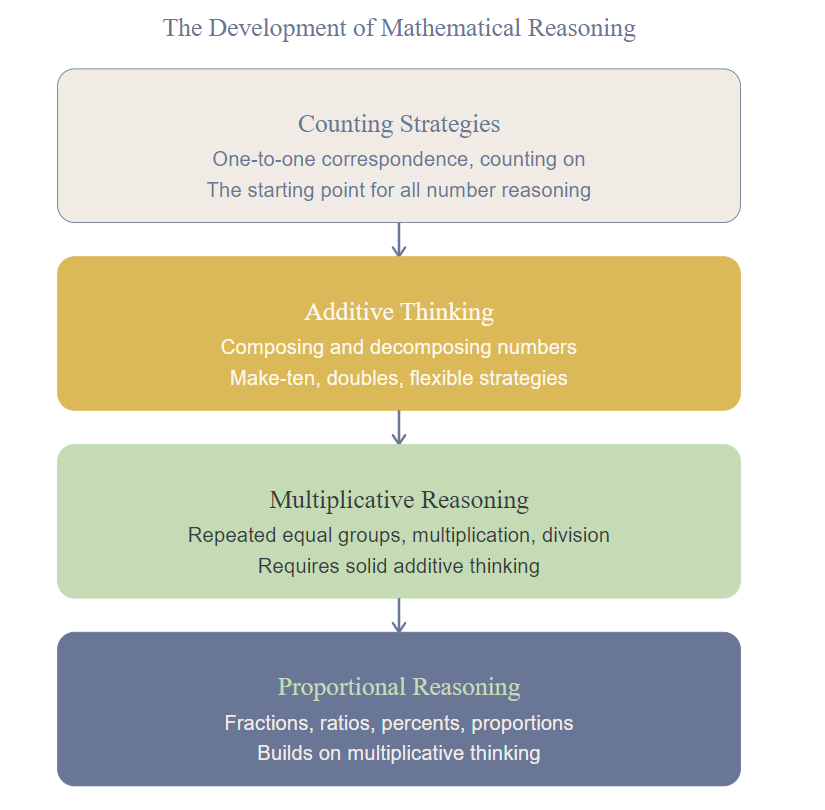
Here’s what that hierarchy looks like starting in first grade:
Students develop the understanding that numbers are made of other numbers. Three dots and four dots compose seven dots. That’s not obvious to every student, and until they see it, they’re counting every time, from the beginning.
⬇️
That understanding builds the break-apart-to-make-ten strategy. A student who knows that 8 needs 2 more to make 10 can decompose the second number to figure out an expression like 8 + 3. But only if they understand that numbers can be broken apart and put back together. If they don’t, the strategy is just another procedure to memorize.
⬇️
Make-ten thinking leads into doubles and doubles plus one. Once students understand composition and decomposition, doubles become anchor facts and can be used to figure out doubles plus one. Instead of seeing 6 + 7 as a new fact to memorize, students see it as 6 + 6 with one more.
⬇️
Doubles and equal groups are the bridge to multiplication. Kids initially understand multiplication as repeated equal groups. We add the same number again and again. That bridge only holds if the additive thinking underneath it is solid.
You have to have the additive thinking to do the multiplicative thinking.
When we skip this sequence, we often don’t find out until third grade, when a student who has been getting answers for two years suddenly can’t do what we’re asking. We want the quick fix, so we start drilling multiplication facts without addressing the first-grade gap that’s showing up in a third-grade classroom.
Harris calls this looking successful at a level without having the mental schema to understand the next one.
Here’s why this matters for number stories specifically.
When we teach students that math is a series of steps and procedures to memorize, they bring that same approach to math stories. Instead of reasoning and making sense of what’s happening, they look for rules to follow. A story about composing two parts to form a total requires students to understand that situation the same way they understand number composition–that two parts come together to form a whole. When the conceptual foundation isn’t there, students reach for an operation instead of trying to make sense of what’s happening in the story.
What “Do I Add or Subtract?” Is Actually Telling You
We grew up in a culture that equated fast with smart, and the way we were taught reflected that. A lot of us were taught that if students just knew their facts, everything else would follow. Fast and correct meant ready, and math and reading were separate subjects.
But when a student asks “do I add or subtract?”, that’s not a reading problem or a motivation problem. That’s a student who was taught to jump to operation before they were taught to understand the story. They’re telling you exactly where the gap is.
If you want to see how that happens in real time, this video breaks down exactly which questions send students straight to operation, and what to ask instead.
Students can’t calculate what they don’t comprehend.
So if you hear that question being asked in your classroom, treat it as a diagnostic. Now you know what it really means. That changes everything about how you respond to it, how you build the understanding that makes it stop showing up, and how you start to push back against the cultural norms that put it there in the first place.
