



May 27, 2026
When students get the right answer, it’s easy to assume they understand.
The problem is the answer alone doesn’t tell you whether or not they have conceptual understanding. A student can give you the correct answer and have absolutely no comprehension of what they just did, and they might not know how they got there either.
This is what happens when we assume understanding based on a number or solution. We move students forward who aren’t ready and excuse students we see as “high flyers” from showing their work because we tell ourselves they don’t need it.
When you watch students draw these models while they’re solving, you get insight into what’s inside their brain. This applies whether students are working through math stories, working on multi-digit addition or subtraction, exploring place value, or making sense of any mathematical idea.
You see misconceptions in the moment, not when they’re cemented in and you’re ready to move to the next unit. You understand who actually gets it and who got lucky with the numbers. You know what to teach next, when to slow down, and when to move on.
Let me show you what I mean.
What Student Models Reveal That Answers Don’t
Imagine two students working on this problem:
Carlos put 6/8 pound of bird seed into a feeder. The next day there was 4/8 pound of bird seed left. How much food did the birds eat?
Both students write 2/8 as their answer. If that’s all you’re checking, both are technically “correct”.
But if you look at their models, you see something completely different.
One drew 8/8 as the whole. Their two parts are 6/8 and 2/8. You can tell immediately that this student misunderstood the relationships occurring in the story.
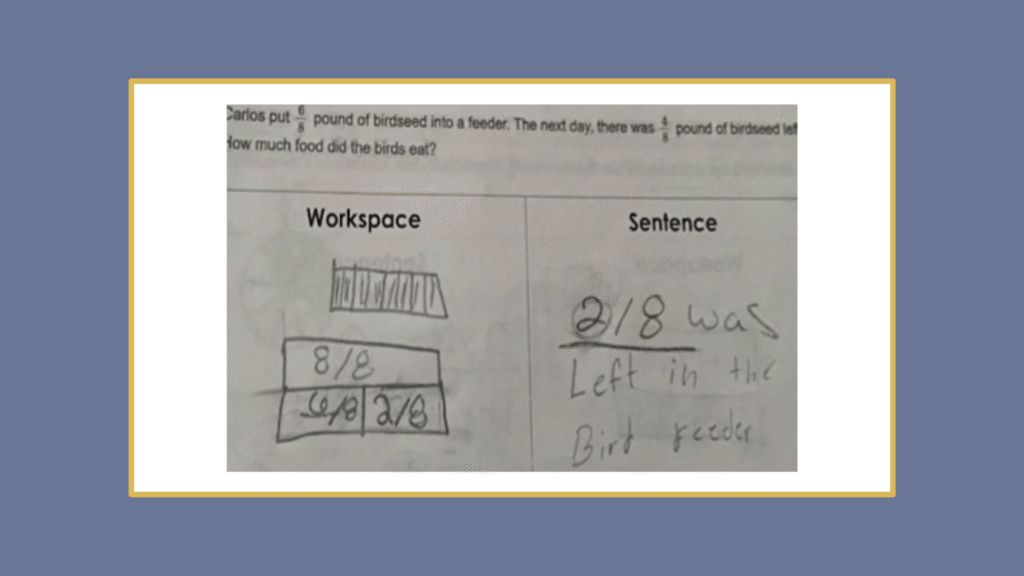
As a teacher, you now know to ask a question like: “Can you tell me what each value represents in the story? Let’s start with 8/8.”
Another shows 6/8 as the total amount of bird seed in the feeder. The parts are 4/8 (what’s left) and 2/8 (what the birds ate). This student understood what was happening.
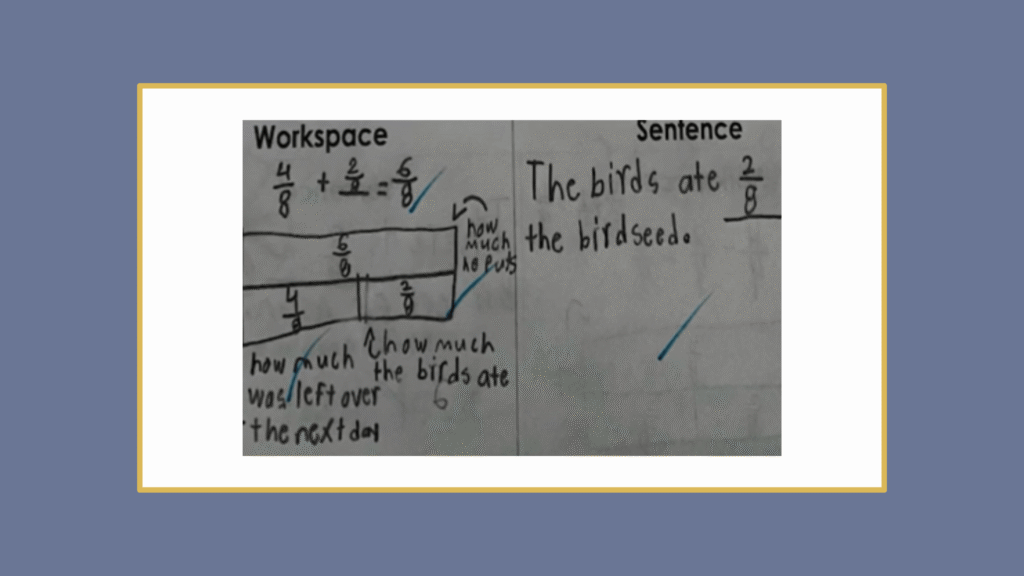
For this student, you might ask: “What does each part of your model represent? Can you explain how you knew what the total was?”
The models reveal whether or not the student understood. If we just looked at the answer, we would assume both students understood what was happening in that story.
Sometimes a student gets the wrong answer but their model reveals productive thinking. If you only saw the wrong answer, you might assume the student doesn’t understand at all. But when you see their model, you know exactly what they do understand and exactly where the breakdown happened. You know what to teach next instead of starting from scratch.
You can see a full breakdown of each of these situations here:https://www.youtube.com/watch?v=AnqClzBbeaA
This same principle, that visible work changes what you see and the instructional decisions you make, isn’t limited to math stories. When a student shows their strategy for 47 + 38, you see whether they understand place value or are just following steps. When they draw an array for multiplication, you see if they grasp equal groups or are counting by ones. The format changes, but the insight stays the same: the work shows you what the answer can’t.
What to Look For (And How to Respond)
So you’re watching students draw. What are you looking for?
This matters for all students, not just the ones we perceive as struggling. We have a tendency to excuse students we see as “high flyers” from showing their work because we tell ourselves they don’t need it. But often, these students lack conceptual understanding and we don’t even realize it. Or maybe they do understand, but we could support them with more efficient strategies. The model is what makes that visible.
Here are a few common issues that show up when students are drawing models for word problems using Structures of Equality or a similar visual representation like Singapore bar models.
▶️ A student draws a total bar that’s a different length than the composed parts. The visual doesn’t match the relationships in the story.
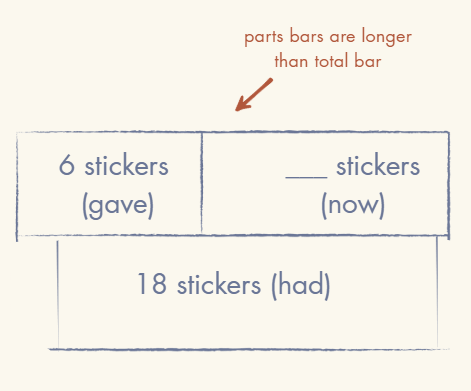
▶️A student labels the bars with the wrong units. For example, they label the bar as “chocolate milk and white milk” instead of “students.” They’ve focused on the details in the story instead of what’s actually being composed, decomposed, or compared.
▶️A student’s model is missing key information. They’ve drawn something, but you can’t tell what the parts represent or how they connect to the story.
When this happens, our goal isn’t to correct, but to clarify.
The questions you ask help the student see what they’re thinking and help you understand where their misconception is so you know how to approach teaching next.
Want to Learn More?
If you want to understand more about why models support thinking and what to look for when students are drawing, my book goes into deep detail. Chapter 4 (Seeing is Understanding) covers how models help students make sense of math stories before they solve. Chapter 5 walks through common issues in student drawings and the kinds of clarifying questions that help students, and you, understand their thinking.
You can find more information about the book here.
