



April 15, 2026
Part 1 of 2
Picture this: you’re in an elementary classroom during math time. A student is stuck on a number story. So you do what most of us do and you start asking questions.
These questions are meant to guide, clarify, and help students get started when a problem feels overwhelming.
But what if these very questions are doing the opposite?
What if, instead of supporting understanding, they are pulling students away from the mathematics in the story?
A Word Problem Worth Looking at Closely
Consider this number story:
Esmerelda had some LEGO sets. She got 6 more for her birthday. Now she has 11 LEGO sets. How many did she start with?
If this was your classroom, what might your students do next? What questions might you ask?
This is exactly the kind of story we unpack in depth in the upcoming Structures of Equality book because the way students interpret a number story reveals far more than whether they can produce an answer.
The Word Problem Questions Most Teachers Ask, and Why They Backfire
Many of us were taught to support students with questions like:
- “What operation do we use?”
- “Are there any keywords?”
- “What’s the question asking?”
- “Can you retell the problem?”
- “Is there extra information?”
These questions feel efficient and focused, but they also share something important in common: they decontextualize the story.
Instead of helping students stay grounded in what’s happening, they shift attention toward procedures and answer-getting. In doing so, they unintentionally communicate that math is about figuring out what to do, not making sense of what is happening.
How These Questions Shape the Way Students Think About Math
Let’s take a closer look at how these questions shape student thinking.
When we ask: “What operation do we use?”, students often respond with:
- “It says ‘more,’ so we add.”
- “I think it’s subtraction because we’re finding what she had before.”
The focus becomes choosing an operation based on cues in the wording rather than making sense of the relationship in the story.
When we ask: “What’s the question asking?”
Students might say:
- “We have to find the answer.”
- “How many she started with.”
It’s not wrong, but it keeps students focused on getting an answer, not understanding the situation.
Why Students Grab Keywords Instead of Making Sense of the Story
Let’s go back to Esmerelda’s story:
Esmerelda had some LEGO sets. She got 6 more for her birthday. Now she has 11 LEGO sets. How many did she start with?
When students are taught to look for keywords, they may notice the word “more” and immediately assume this is an addition problem. They might write 6 + 11 = ___ because they’ve been trained to associate certain words with certain operations.
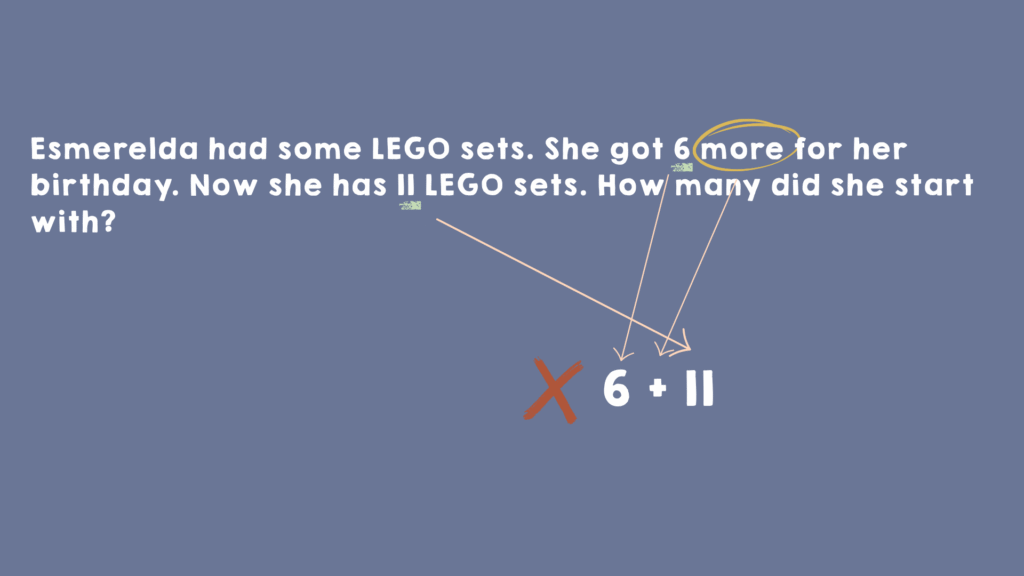
Even when students don’t begin with keywords, the question: “What operation do we use?” teaches them to hunt for clues that signal a procedure.
So instead of making sense of the story, students begin to scan for trigger words, pull out the numbers, and choose an operation, or “plug and chug”. When that happens, they lose the focus on the relationship between them.
In Esmerelda’s story, the 11 is the total after two parts are composed, and the 6 is one of those parts. But when students are scanning for keywords or operations, they often miss that entirely because they’re looking for a procedure, not making sense of a situation.
The story, the very thing meant to contextualize the mathematics, gets pulled apart.
The Real Problem with Keyword Strategies in Math
Word problems aren’t meant to be decoded. They are meant to be understood and exist to contextualize mathematics.
But when we rush to operations or keywords, we interrupt that process. We ask students to step outside the story before they’ve had a chance to make sense of it.
That’s the opposite of what we want. We want students moving back and forth between the story and the math, understanding what’s happening before they ever think about what to do.
An Invitation to Reflect and a Preview of Part 2: What to Ask Instead
Take a moment to think about the questions you ask most often.
Which ones help students stay grounded in the story? Which ones might be pulling them away from it?
If our questions are shaping the math students see, what kind of math are we inviting them to do?
In Part 2, we’ll look at what to ask instead, questions that keep students inside the story, help them see relationships clearly, and build meaningful mathematical understanding.
