



April 22, 2026
How to Keep Students Connected to the Story
Part 2 of 2
In Part 1, we explored how common questions like “What operation do we use?” can unintentionally pull students away from meaning.
These questions are often meant to help. But they shift students’ attention away from what’s happening in the story and toward figuring out what to do. They tend to reply with something like: “It says ‘more’, so we add.” The problem is this drives kids toward hunting for keyword cues, which is unreliable.
So what should we ask instead?

Starting with the Story, Not the Operation
Let’s revisit the same problem from Part 1:
Esmerelda had some LEGO sets. She got 6 more for her birthday. Now she has 11 LEGO sets. How many did she start with?
When students hear a story like this, it’s easy for the focus to shift quickly to numbers and operations, especially when our questions point them there.
Instead, we want to give students time to make sense of what’s happening before they think about how to solve it.
What to Ask Instead: Questions That Build Word Problem Comprehension
If we want students to stay focused on what’s happening in the story, our questions have to do the same.
That might sound like starting with something simple:
- “What’s happening in this story?”
- “Who or what is this story about?”
These questions don’t ask students to solve anything yet. From here, we can begin to focus their attention more carefully:
- “Is there an action?”
- “What do we know?”
- “What are we trying to figure out?”
As students begin to describe what’s happening, we can support them in naming the relationship:
- “What’s being composed or decomposed?”
- “What’s being compared?”
- “What is the math main idea in this story?”
These questions help students visualize what’s happening and begin to understand the relationships in the story before they ever think about solving it.
How These Questions Change the Way Students Think
When students are given time and space to make sense of the story, their thinking begins to shift.
Instead of looking for an operation, they start describing what’s happening:
- “She has 11 LEGO sets now.”
- “She got 6 more LEGO sets.”
- “We don’t know how many she had at the start.”
Now, they can begin to name the relationship, or math main idea. “This story describes decomposing a total into two parts.”
This keeps the focus on comprehension, instead of jumping to calculation.
How the Structures of Equality Help Students See Relationships
Once students can name the math main idea, they’re ready to represent it.
This is where the three Structures of Equality come in. The structures are visual representations of the relationship students have already described. They give students a way to make their thinking visible and keep it connected to the story.
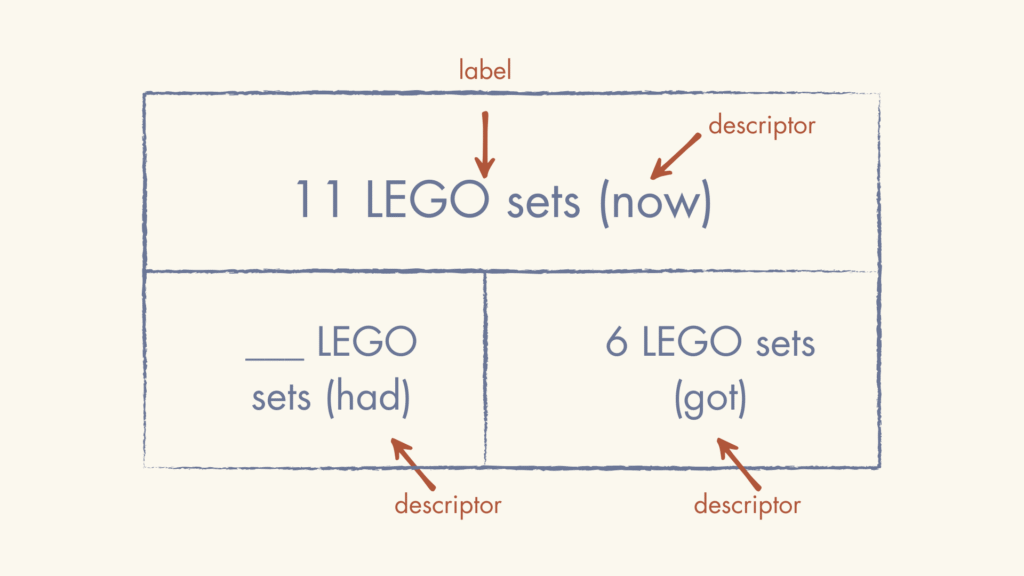
Every structure includes three essential elements: the values, labels that describe what those values represent, and a representation of equality. When those pieces are in place, the mathematics stays grounded in the story rather than turning into something abstract and disconnected.
What This Looks Like with Esmerelda’s Story
Let’s go back to Esmerelda’s story and walk through what this might sound like in a classroom.
Students begin by describing what’s happening:
- “I think this story takes place at Esmerelda’s birthday party.”
- “It’s about Esmerelda and her LEGO sets.”
- “She got 6 LEGO sets for her birthday and now she has 11.”
From there, a teacher might ask: “What’s the math main idea in this story?”
A student might say: “The math main idea is decomposing a total into two parts. The total is 11. One part is 6. The other part is what we’re trying to figure out.”
Now the relationship is clear. Students can represent it using a PET Structure of Equality with values, labels, and a representation of equality, and then choose a strategy to solve.
Understanding comes first; students can’t calculate what they don’t comprehend.
From Answer-Getting to Sense-Making: The Shift That Changes Everything
This shift may seem small, but it changes what students pay attention to. Instead of focusing on what to do, students begin by making sense of what’s happening and how the quantities are related.
| Traditional Focus | SoE Focus |
| Find the operation | Understand the relationship first |
| Look for keywords | Visualize what’s happening in the story |
| Solve | Make sense of the story and model it accurately |
Try This Tomorrow: One Small Change to How You Introduce Word Problems
Take one number story you plan to use. Before students solve it, ask:
- “What’s happening in the story?”
- “What do we know?”
- “How are these amounts related?”
Then listen.
You may notice students beginning to describe relationships, not just answers—and building understanding before they ever consider an operation.
Free Resources: Question Stems for Each Structure
To explore this further, including question stems and examples for each structure, check out these free resources:
