




December 10, 2025
Number stories with comparative relationships are some of the most challenging problems students encounter. Add in multiplicative relationships: stories with “twice as many,” “half as much,” or “three times as many”, and students can quickly become overwhelmed.
One of the reasons Structures of Equality (SoE) is so effective is because it helps students see what’s happening in the story before they begin solving. With the right structure, students make sense of the relationship long before they start writing equations.
The Structures of Equality (and Where Multiplicative Compare Fits)
SoE includes three core structures:
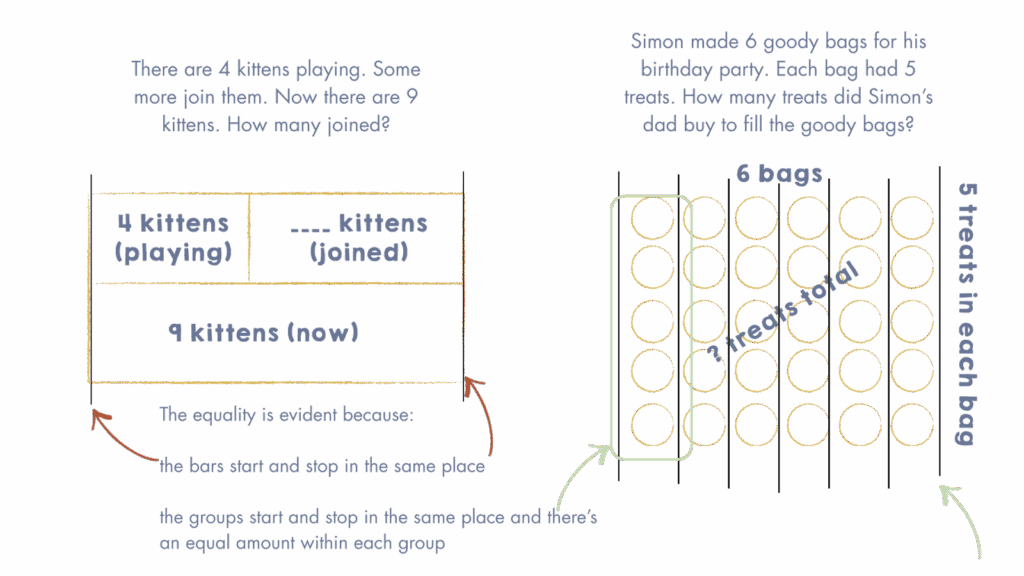
- Parts Equal Total
- Repeated Equal Groups
- Compare
There’s also a fourth structure: Multiplicative Compare
Multiplicative Compare falls under the umbrella of Compare because the math main idea still describes comparing two distinct values. The difference is how the comparison is being made.
A Compare story focuses on:
• how much more or fewer one quantity is than another
A Multiplicative Compare story focuses on:
• how many times greater or smaller one quantity is than another
The underlying structure stays the same, bars aligned on one end with a line of equality, but the reasoning becomes multiplicative instead of additive.
Compare vs. Multiplicative Compare: A Quick Guide
Use Compare when the story describes:
- how much more or fewer
- an additive relationship
Use Multiplicative Compare when the story describes:
- a scaled relationship
How Do We Know When a Story Is Best Represented by a Multiplicative Compare Model?
We always begin by identifying the math main idea. Once we’ve established that the story is comparing two distinct amounts, the next question becomes:
Is the comparison a scaled relationship?
Example: A blue hat costs $6. A red hat costs three times as much as the blue hat.
Math main idea: We are comparing the cost of two hats.
Type of comparison: The red hat is three times the cost of the blue hat.
Structure: Multiplicative Compare

Use the Structure to Make the Relationship Visible
What makes Multiplicative Compare so powerful is that it shows how the scaled relationship works
At the center of this structure is one critical feature, the line of equality.
The line of equality shows the point up to which the two values are the same. In Multiplicative Compare, this is essential.
Students can see:
- where the bars line up
- where the values match
- how the extra groups create the “times as much” relationship
This is what makes Structures of Equality more precise than traditional bar models. Students aren’t just drawing bars; they’re showing the relationship between bars.
Retell to Reveal Understanding
A student truly understands what’s happening in a story when they can retell what’s happening using their model.
They should be able to:
- identify which value is greater
- point to the representation of equality
- show how many times greater or smaller one quantity is
- explain the relationship in their own words
Example retell:
“Up to here, they’re the same. These extra groups show that the red hat costs three times as much as the blue hat.”
If a student can do that, they understand the relationship, not just the operation.
How CRA Supports Multiplicative Comparisons
If you’ve explored the CRA framework (Concrete-Representational-Abstract) in earlier SoE blogs, you already know that CRA isn’t a linear sequence. Students don’t move from hands-on tools to drawings to equations in a set order. They move between these phases as needed to make sense of the math main idea.
Rather than diving deeply into CRA here, I’ll point you to two videos that show what CRA looks like specifically for Multiplicative Compare:
📹 Math Main Idea: Multiplicative Comparisons
📹 Modeling Multiplicative Comparisons with Snap Cubes and Drawings
What you’ll notice in these videos:
- Students begin concretely to see what “three times as much” actually looks like.
- The line of equality appears in both the concrete and drawn models.
- Students move naturally between concrete and representational forms as they make sense of the scaled relationship.
- The same flexibility applies anytime students model stories where the math main idea describes multiplicatively comparing two or more distinct sets. Concrete, representational, and abstract ideas work together, not in a strict sequence.
If you want a deeper look at how CRA integrates into SoE more broadly, these two earlier blog posts walk through examples in detail:
These are great foundational reads, and the videos above show exactly how the same continuum applies when the comparison is multiplicative instead of additive.
Want to Learn More?
This blog is adapted from part of Chapter 7 of my upcoming book on Structures of Equality, where I go even deeper into both the Compare and Multiplicative Compare models. You’ll find more examples, visuals, classroom stories, and step-by-step guidance for teaching comparison in a way that truly helps students make sense of the math.
If you’re reading this before Summer 2026: You can add your name to the interest list to be the first to know when the book launches and get early access to bonus resources.
If you’re reading this after Summer 2026: You’ll be able to dive deeper into this work inside the book, along with clear examples, student models, and full support for teaching all four Structures of Equality. Learn more on my website.
