



December 6, 2023
Updated 12.31.25
The Power of Growth Mindset
Growth mindset get talked about a lot, but it’s more than just a catchphrase. It’s a shift we can help students make so they feel, and are , more successful. And there’s solid research showing how mindset impacts achievement.
So, what exactly is growth mindset?
Carol Dweck, the leading researcher in this work, defines it as “when students understand that their abilities can be developed,” (Dweck, 2014). It’s not about just grit or effort. It’s about seeing learning as a process and recognizing that skills are developed over time.
What a Fixed Mindset Sounds Like
When students (and adults) have fixed mindsets, we hear phrases like:
- “I’m no good at math.”
- “I can’t do that.”
- “I give up.”
- “I’m not a math person.”
Once students start internalizing these beliefs, learning becomes an uphill battle–not because they can’t do the math, but because they’ve already decided they can’t. It turns into a self-fulfilling cycle. They don’t see themselves as capable, so they don’t persist, and then the struggle reinforces what they already believed.
It’s not that they can’t do the math. It’s that they don’t believe they can.
When Mindset Gets in the Way
This mindset becomes glaringly obvious when we present students with story problems. If there’s one thing all math teachers can agree on, it’s that story problems are the bane of their existence.
We previously looked at the Standards for Mathematical Practice and how they come to life when students are using Structures of Equality to solve word problems. But mindset underpins all of it. If students don’t believe they can make sense of the problem, they won’t engage in the thinking it requires.
Empowering Students
I created Structures of Equality because I was tired of watching capable students give up I knew there had to be a way to allow all students to access and comprehend word problems. A tool that could help students develop a growth mindset if they didn’t already have one.
I tried all the traditional approaches and had seen key words fail students time and time again. I watched students who had been excited and eager to learn become defeated. Over time, their mindsets became fixed.
Common Pitfalls
As a teacher, I look back on some of the mistakes I made. I wanted to see my kids succeed, so I gave them tips or tricks to get the “right” answer. Then, meaning well, I told them how smart they were when they solved a problem correctly. Many teachers, with the best intentions, unknowingly hinder their students’ growth (like I did) by offering shortcuts and praising intelligence over effort.
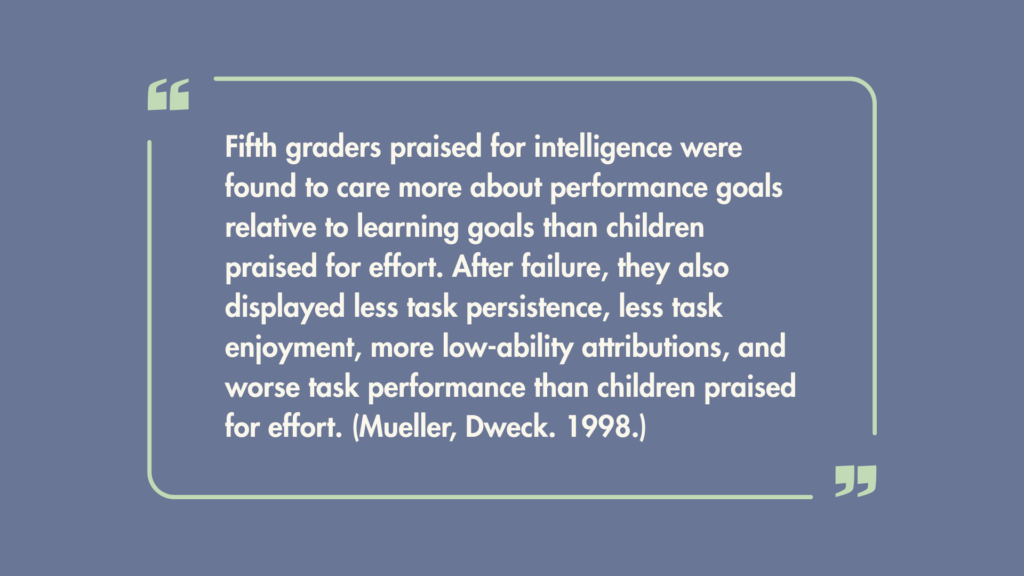
Mueller and Dweck’s research confirms what many of us have learned the hard way:
So what can we do?
Jo Boaler talks often about how a growth mindset can be built, but it takes intentional work. The good news is that it’s never too late to develop it. But the longer we have a fixed mindset, the harder it is to overcome. And it’s particularly pervasive in math.
So where do we start?
Luckily, there are loads of resources available. On Jo Boaler’s site, you can explore a plethora of tools to help you get started. When it comes to solving word problems, you can engage students in using Structures of Equality to comprehend and successfully tackle word problems. To help you get started, there are resources available on my website to help students think deeply, not guess quickly.
Conclusion
Fostering growth mindset isn’t just an educational philosophy; it’s a fundamental shift in the way we approach learning. The path may be challenging, but with tools like Structures of Equality and the wisdom of researchers like Carol Dweck and Jo Boaler, we can guide students to view challenges as opportunities for growth. The first step is to embrace the potential in every student.
Renaissance. What is growth mindset? EdWord. URL: https://www.renaissance.com/edword/growth-mindset/#:~:text=without%20effort.%E2%80%9D%20(-,Dweck%2C%202015),essential%20for%20great%20accomplishment.%E2%80%9D%20(
Mueller, C. M., & Dweck, C. S. (1998). Praise for intelligence can undermine children’s motivation and performance. Journal of Personality and Social Psychology, 75(1), 33–52. https://doi.org/10.1037/0022-3514.75.1.33
