

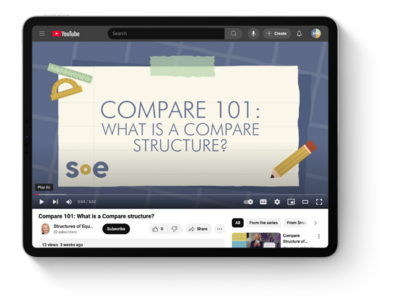


January 24, 2024
Updated January 28, 2026
The problem with traditional math education
I bet you’ve heard people say “I’m not good at math.” or “I’m not a math person.” Maybe you’ve even said it yourself.
Here’s what that usually means: They were taught math as a series of steps to complete. They learned to memorize formulas and follow procedures. They were never taught to comprehend.
They see math as abstract and irrelevant, difficult to understand because it never made sense in the first place.
Imagine how you’d feel about reading if all you learned how to do was decode words without understanding what they meant.
The power of visual models in math
As math becomes more complex, we teach with formulas and rote procedures instead of taking time to work concretely with visual representations. Students might think that drawing a picture is unnecessary, or even babyish.
But visual representations are important at all levels of mathematics. They help students see the math. When we can visualize what’s happening within a problem, abstract concepts become clear. Students can communicate their understanding (or misunderstanding)..
Consider this: “When students create their own visual representations, they have a way to show their understanding (or misunderstanding that you can then correct)… students who use accurate visual representations are six times more likely to correctly solve problems compared to students who do not use them.” – Kim Greene
Six times more likely. That’s powerful.
What is an example of a visual representation?
. Visual representations include manipulatives, number lines, pictorial representations, diagrams, and charts. They show mathematical quantities and relationships in ways students can see and understand.
This is why I call Structures of Equality (SoE) a reading comprehension tool. Students visualize problems and draw representations to show how they see the relationships within the number stories.
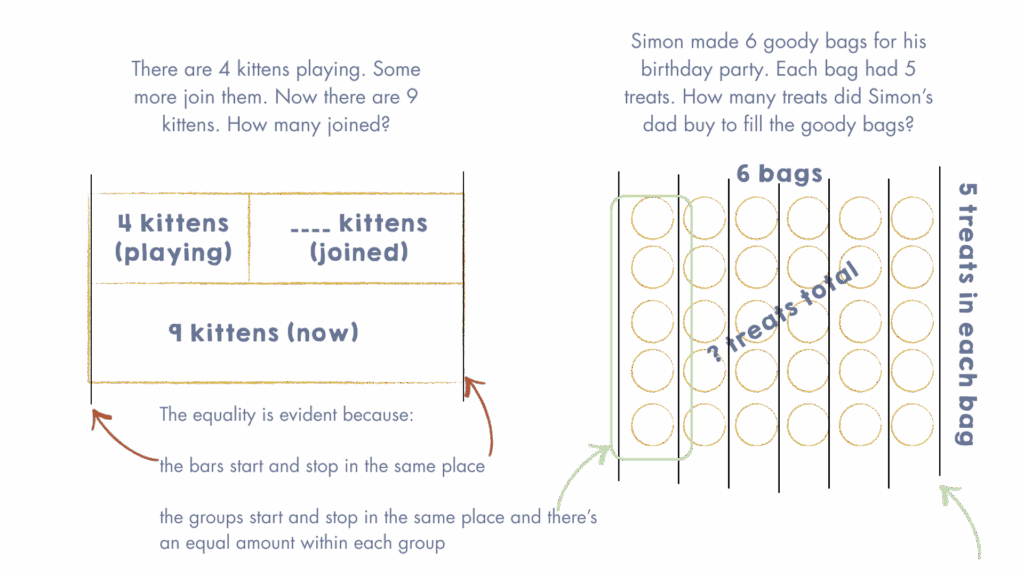
According to Dr. Valerie Faulkner, “Visual representations spark the visual part of the brain and help us to translate between fully embodied concrete objects and the numerical symbols we use to represent them. But not all visual representations are equally powerful. Representations that support the learner in processing numerical relationships in a structured and reliable way are critical to internalizing mathematical meanings and relationships.
The Structures of Equality turn visual thinking into a linear and comparative tool that can then be used to interpret and develop mathematical ideas, relationships, and language– from arithmetic to algebra to geometry.“
How exactly do visual representations help?
Brain research shows us what happens when students engage with visual representations.
“When students work with symbols, such as numbers, they are using a different area of the brain than when they work with visual and spatial information, such as an array of dots.” Researchers found that mathematics learning and performance was optimized when the two areas of the brain were communicating (Park & Brannon, 2013).
Additionally, they found that training students through visual representations improved students’ math performance significantly, even on numerical math, and that the visual training helped students more than numerical training.” (https://www.youcubed.org/resources/visual-math-improves-math-performance/)
This research aligns with the Common Core Standards for Mathematical Practice.
The Standards for Mathematical Practice
The Standards for Mathematical Practice outline what makes students proficient at mathematics. Practice Standard 4 is to model with mathematics.

Why is it important to model with mathematics?
Mathematically proficient students can:
- identify important quantities in real-life situations
- model the relationship between quantities using tools such as diagrams and graphs
- analyze relationships and make conclusions
“They routinely interpret their mathematical results in the context of the situation and reflect on whether the results make sense, possibly improving the model if it has not served its purpose.” (Common Core State Standards Initiative)
Conclusion
Visual representations in math develop deep, conceptual understanding. They increase achievement and shift students’ mindsets about what they can do in math.
Imagine never again hearing “I’m not good at math” or “This is boring.” Imagine not watching another frustrated student give up and feel negatively about themselves.
Visual representations make that possible.
