



March 25, 2026
In my last article, I showed you a three-day progression for teaching a numberless word problem. We removed the numbers, named the math main idea, modeled the story with a structure, and then brought the values back in.
That progression works well, but it’s not always the strategy that makes the most sense for every story.
The goal of numberless word problems is always the same: help students see the relationship clearly by separating it from the calculation. This is why it’s such an effective strategy to pair with the Structure of Equality framework.
As described in a CollectEdNY post, “Students can’t jump into random calculations if there are no numbers and no questions to answer.”
When we temporarily remove what students usually grab onto, we create space for discussion, close reading, and shared sense-making before calculation ever begins.
Four Approaches to Understanding Word Problems
While the goal is always the same, what changes is the move we choose to get them there. There are 4 ways you might approach this strategy:
- Go fully numberless.
- Adjust the values to whole numbers less than 10.
- Remove the question.
- Present the question as a statement that includes the solution.
The way you decide which move to use is based on the structure of the story itself. Let me show you what I mean.
When to Go Fully Numberless in a Word Problem
▶️ Original Story (3rd Grade):
Ms. Cortez wanted to plant a tomato garden. She bought 249 carrot seeds on the first day. Then, she bought 386 carrot seeds on the second day. How many carrot seeds did she buy over the two days?
Before we’ve even talked about what’s happening, many students are already lining up 249 and 386. Others are overwhelmed by the size of the numbers. Either way, they’ve skipped the relationship.
This story lends itself well to going fully numberless.
▶️ Numberless Version:
Ms. Cortez wanted to plant a carrot garden. She bought some carrot seeds on the first day. Then she bought some more carrot seeds on the second day.
Teacher: What’s the thing we’re counting or comparing?
Student: Seeds.
Teacher: What’s the action?
Student: She’s buying them.
Teacher: How many groups of carrots do we have?
Student: Two.
Teacher: So what does that tell us about the relationship?
Student: She’s putting the two amounts together.
Once students can articulate the math main idea, composing two groups to form a total, they model that relationship with the corresponding structure, Parts Equal Total (PET).
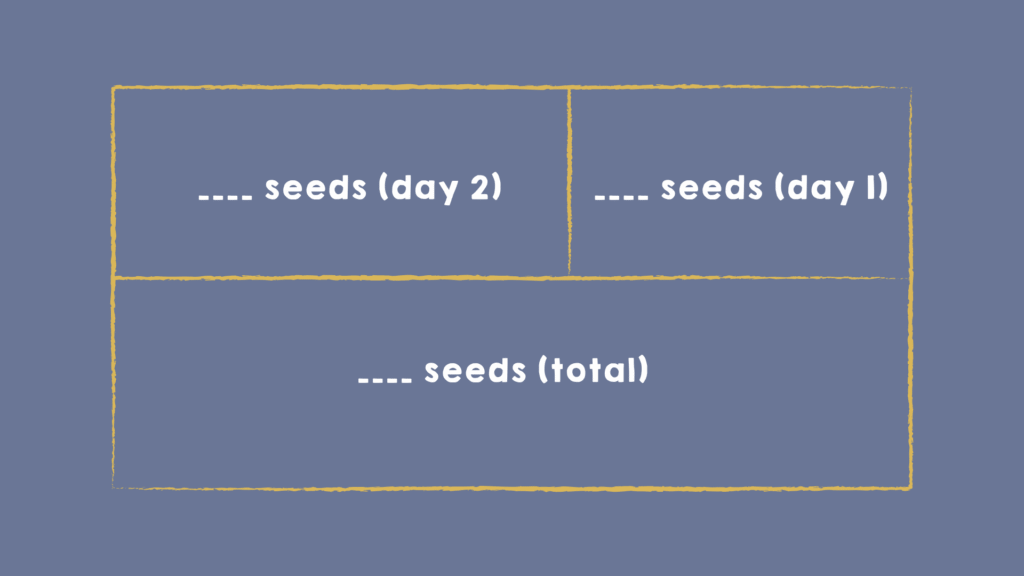
Once the PET structure is labeled and the relationship is clear, then we bring back 249 and 386. The numbers now fit inside something that already makes sense.
When to Adjust the Numbers Instead of Removing Them
▶️ Original Story (4th Grade):
Samantha’s airplane flew 6.999 meters. Diego’s flew 8.2 meters. Whose airplane flew the farthest?
Comparing decimals can feel intimidating. Students start worrying about lining up digits instead of asking what the story is actually about. So instead of removing numbers, we adjust them.
You can also use this strategy when working with larger numbers. The key is to use whole numbers under 10.
▶️ Alternate version
Samantha’s airplane flew 7 meters. Diego’s airplane flew 8 meters. Whose airplane flew the farthest?
Teacher: What are we trying to figure out?
Student: Whose airplane went farther.
Teacher: So what kind of relationship is this?
Student: A comparison.
Teacher: Which structure do we use when the math main idea describes a comparison relationship?
Student: Compare
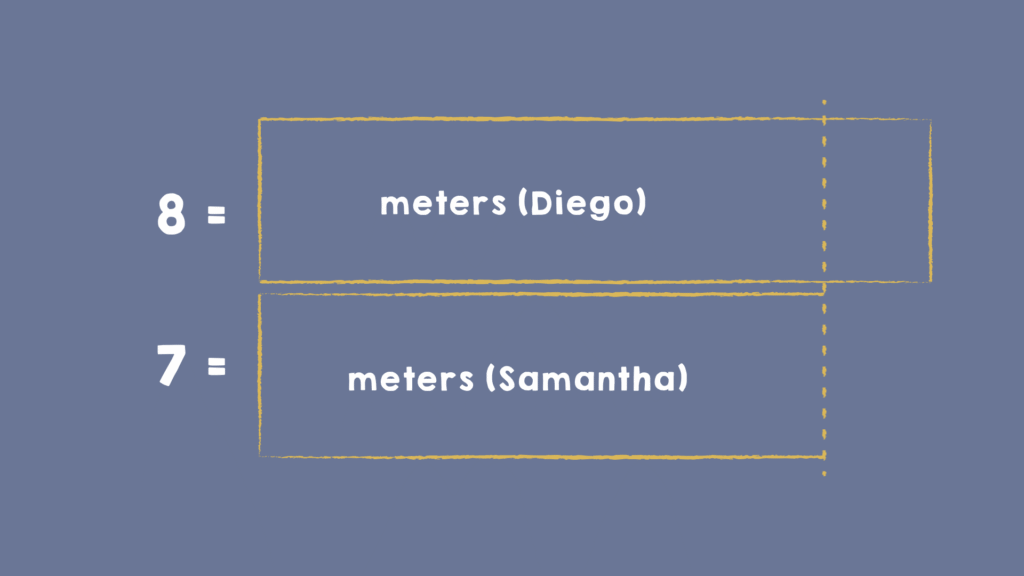
Once students understand that the math main idea of this story describes comparing two distinct values, you bring back the values 6.999 and 8.2.
How to Approach “Multi-Step” Word Problems Using the Math Main Idea
▶️ Original Story:
Mr. Pullen’s class wants to go on a field trip that costs $145. His class can earn money by working at the school store for 6 weeks at $15 per week. How much more money does the class still need?
There’s a lot happening here.
If we jump straight to the question, students often grab one number and ignore the rest, so this story lends itself to leaving the question off.
▶️ Version Without the Question:
Mr. Pullen’s class wants to go on a field trip that costs $145. They will work at the school store for 6 weeks and earn $15 per week.
Teacher: What’s happening in this story?
Student: They’re trying to earn money for a trip.
Teacher: What’s the thing we’re counting or comparing?
Student: The money they earn each week, and then I think we’ll compare that with the total cost.
Teacher: So it sounds like there’s more than one math main idea.
Student: Yes, first we have to figure out what they earned and that part describes composing equal groups. Then, I think we’ll need to compare it to the total cost to figure out the solution.
Teacher: What structures would we use to model those relationships?
Student: Repeated Equal Groups (REG) then Compare
Teacher: Let’s start with our REG structure.
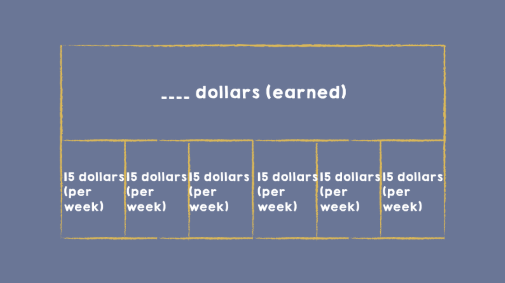
After students draw the model and then solve for the total dollars earned, revisit the math main idea.
Teacher: Earlier we predicted the second math main idea would describe comparing two amounts. Let’s revisit our number story to see if that still makes sense.
Mr. Pullen’s class wants to go on a field trip that costs $145. They will work at the school store for 6 weeks and earn $15 per week.
We now know that the students earned $90 at the school store and the field trip costs $145.
→ At that point, “How much more do they need?” grows naturally from the situation.
Student: We have two different amounts, so yes, I still think we need to compare.
Teacher: Let’s model this with a Compare structure.
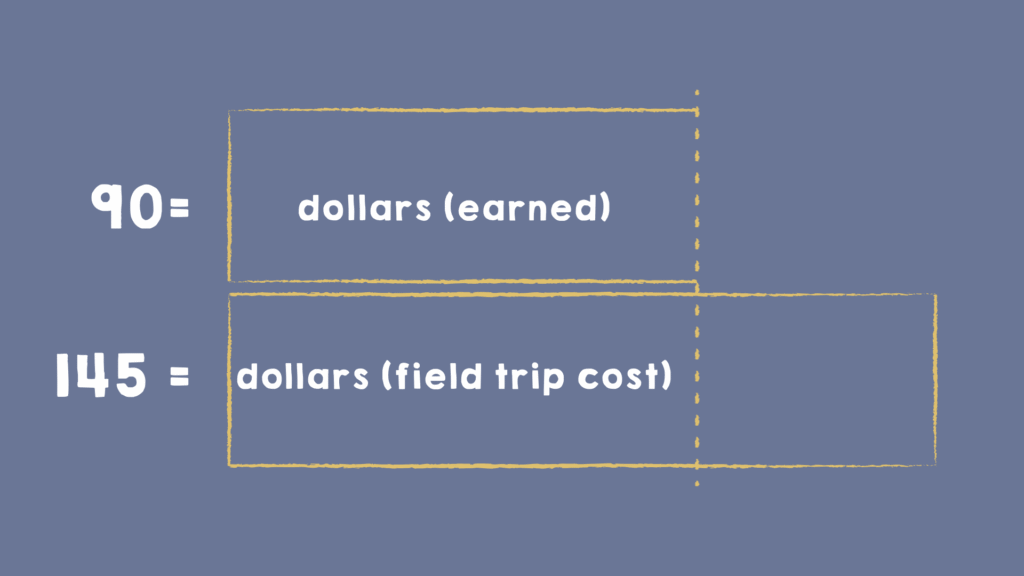
Education Week reinforces this approach: “Students should learn to visually represent different types of word problems in the form of bars, tables, number lines, or schematic diagrams before they jump to solving the equation.”
How to Teach Comparison Word Problems Without Keyword Tricks
▶️ Original Story:
Granny baked 214 chocolate chip cookies and 356 sugar cookies. How many fewer chocolate chip cookies did she bake than sugar cookies?
The word fewer trips students up. They’ve been trained to treat it like a subtraction signal, even though it’s sometimes used to describe a comparison relationship.
So instead of presenting this as a question, we present it as a statement that includes the solution. This allows us to have deep conversations about the relationship first.
▶️ Version With the Question as a Statement
Granny baked 214 chocolate chip cookies and 356 sugar cookies. She baked 142 fewer chocolate chip cookies than sugar cookies.
Teacher: What’s the thing we’re counting or comparing?
Student: The two kinds of cookies.
Teacher: What do we know about the cookies?
Student: One amount is less than the other.
Teacher: So what’s the math main idea of this story?
Student: It describes comparing two amounts.
We talk about what “fewer” actually means in context, and then model the relationship with a Compare structure.
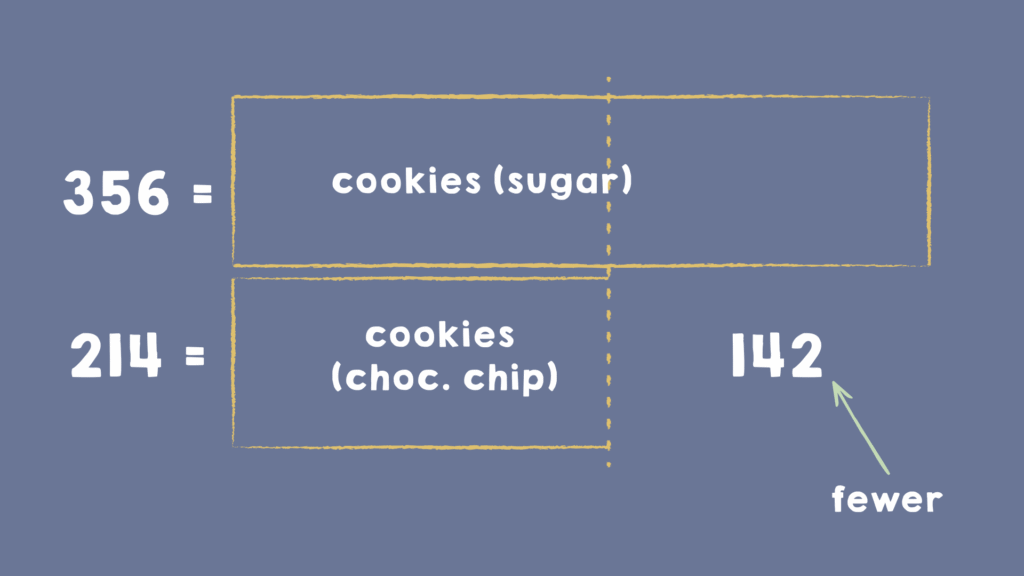
To see if students understand the comparison relationship, you could have them try to model this story with smaller numbers where we don’t know the larger amount of cookies, such as: “Granny baked 10 chocolate chip cookies and some sugar cookies. She baked 4 fewer chocolate chip cookies than sugar cookies. How many sugar cookies did she bake?”
Teaching Students to Focus on Relationships Before Calculation
Numberless word problems provide one way to remove whatever is blocking comprehension.
So before you decide how to introduce a problem, pause and ask yourself: What might distract my students from seeing the relationship clearly?
- If the numbers are the distraction, go fully numberless.
- If the values add unnecessary complexity, adjust them.
- If the question rushes students into solving, leave it off.
- If vocabulary is driving procedural thinking, turn the question into a statement and analyze the relationship first.
When we make that decision intentionally, we shift the classroom conversation. That’s when students stop looking for cues and start looking for meaning. They learn to expect that every number story describes a relationship, and that their first job is to understand it.
