




March 18, 2026
In a previous article, I talked about what numberless word problems are, why they work, and how to get started. If you haven’t read it yet, I’d encourage you to check it out first; it lays the foundation for everything we’re going to do here.
Today, I want to show you what it actually looks like to use numberless word problems over the course of three days with the same story. It’s a progression from making sense of what’s happening, to building a structure, to finally solving with full understanding.
We’ll use this 2nd grade problem from the NC DPI Unpacking Document:
| There are 15 stickers on the page. Cindy put some more stickers on the page. There are now 22 stickers on the page. How many stickers did Cindy put on the page? |
The math main idea? This story describes groups being composed to form a total. Or, depending on how you read it, a total is being decomposed into two groups. Both descriptions fit this story. Either way, the structure we’ll use is a Parts Equal Total (PET).
Here’s the thing about this problem: it’s deceptive. Students who rely on keywords or number-grabbing might rush past the real question. This three-day progression slows things down and builds the kind of comprehension that actually sticks.
Let’s walk through it.
Day 1: Make Sense of the Story Before the Numbers Arrive
On Day 1, you’re not going to talk about numbers at all. You’re going to present the story without them, and without the question. Your only job today is to help students understand what’s happening.
| Numberless version:There are some stickers on the page. Cindy put some more stickers on the page. |
What This Looks Like in the Classroom:
Teacher: What are you picturing in your mind when you read this?
Teacher: What’s the setting of this story?
Student: Maybe a bedroom.
Teacher: Right. And who are the characters?
Student: Cindy.
Teacher: Good. What is Cindy doing?
Student: She’s putting stickers on a page.
Teacher: Is there an action in this story?
Student: Yeah, she’s adding more stickers.
Now you’re ready to move into the math main idea. This is the heart of Day 1.
Teacher: What is the thing we’re counting in this story?
Student: Stickers.
Teacher: And what’s happening to the stickers? Are they being put together (composed) or taken apart (decomposed)?
Student: Put together. There are some on the page and then Cindy adds more.
Teacher: So we have one group of stickers and then another group of stickers being added to it. What does that make?
Student: A bigger group of all the stickers together.
Teacher: Exactly. The math main idea of this story describes two parts, the stickers already on the page and the stickers Cindy added, being composed, or put together, to form a total. That’s what this story is really about.
| 💡 Teacher note: Notice we haven’t touched a number yet. Students are building a mental model of this situation before anything numerical enters the picture. That’s the whole point of Day 1. |
Day 2: Draw the Structure: Labels and Descriptors First, Values Later
Day 2 begins with a recap. Don’t assume students remember everything from yesterday. Briefly revisit the story and what they discovered.
Teacher: Yesterday we read a story about stickers. Who can remind us what was happening in that story?
Student: Cindy was putting more stickers on the page.
Teacher: And what was the math main idea?
Student: The story described two parts being put together to make a total.
Teacher: Perfect. So if we have two parts being composed to form a total, what structure would help us represent that?
Student: Parts Equal Total.
Now it’s time to draw, but still no numbers.
Have students draw a PET structure and include labels and descriptors but leave the value boxes blank.
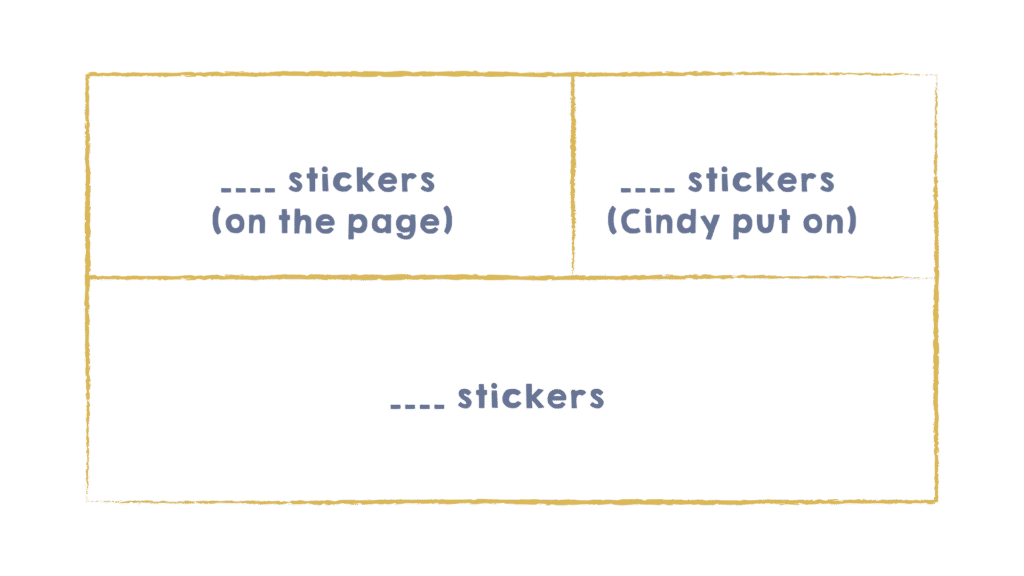
Teacher: When we draw our PET structure, what do we always need to include in each bar?
Student: Values, labels and descriptors.
Teacher: Right. We’re going to leave the values blank for now. We’ll add those tomorrow. But we can absolutely add our labels and descriptors. What’s the label for our unit? What are we counting?
Student: Stickers.
Teacher: So ‘stickers’ goes where?
Student: In all the sections.
Teacher: And can we describe the parts a little more specifically? What do we know about the stickers in this part?
Student: They were already on the page.
Teacher: And this part?
Student: The ones Cindy put on.
Teacher: Great. And the total?
Student: All the stickers on the page now.
Students now have a fully labeled PET structure with blank value boxes. The visual tells the whole story without a single number. This is the moment comprehension and structure connect.
| 📥 Free resource: Download the Example Questions: PET from the SoE website to see the question stems that support this kind of discussion. |
Day 3: Introduce the Numbers for Contextual Understanding
| Full problem:There are 15 stickers on the page. Cindy put some more stickers on the page. There are now 22 stickers on the page. How many stickers did Cindy put on the page? |
Teacher: Read the problem. What changed from what we’ve been working with?
Student: There are numbers now!
Teacher: Right. We’ve already got our structure drawn with labels from yesterday. Where do the numbers go?
Student: 15 goes in the first part, the stickers already on the page.
Teacher: And 22?
Student: That’s the total. All the stickers on the page now.
Teacher: So what’s missing?
Student: How many Cindy put on. That’s the unknown.
Teacher: Where does the unknown go in our structure?
Student: The second part bar.
Students fill in the values on the structure they built yesterday. Now ask them to retell the story using the structure.
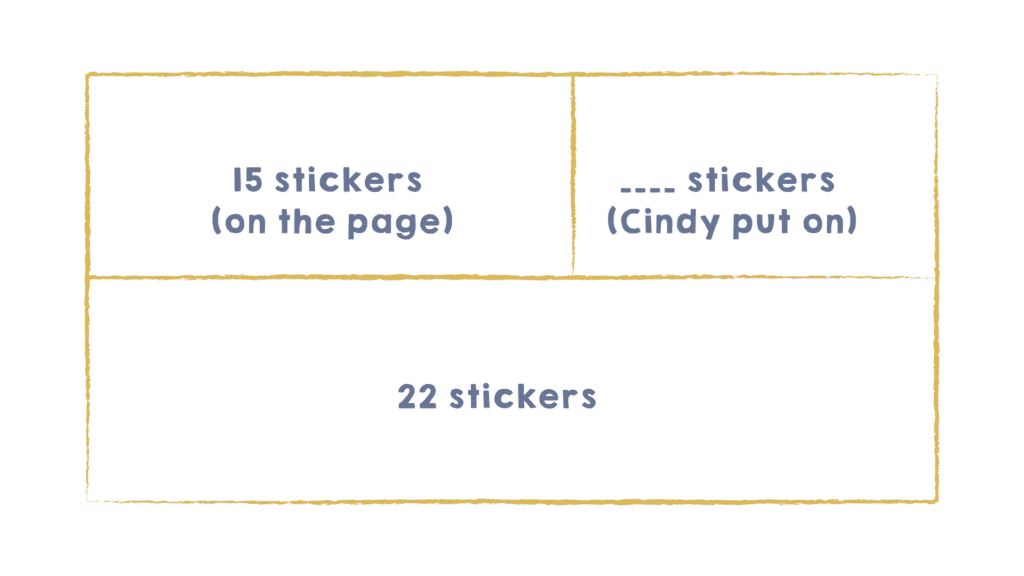
Teacher: Can someone use our PET structure to retell what’s happening in this story?
Student: There are 15 stickers on the page, that’s one part. Cindy adds some more. That’s the other part we don’t know yet. We put them together and they make 22 stickers total.
Teacher: And what is this question asking us to find?
Student: The part we don’t know—how many stickers Cindy put on.
From here, students can solve using whatever strategy makes sense to them. They’re not guessing at an operation. They understand the relationship, and that understanding points them to a solution path.
| 💡 Teacher note: Notice that this problem works in both directions. You could read it as two parts composing a total (15 stickers + Cindy’s stickers = 22), or as a total being decomposed into parts (22 total stickers broken into what was there before and what Cindy added). Both readings lead to the same PET structure and the same solution and discussing both deepens comprehension. |
What Happens When a Word Problem Has More Than One Math Main Idea
Once your students are comfortable with this progression, you’ll want to use it with more complex problems, ones that have more than one math main idea. This is where the strategy really proves its value.
Here’s what’s commonly referred to as a two-step problem, also from the NC 2nd Grade DPI Unpacking Document:
| There are 9 peas on the plate. Carlos ate 5 peas. Mother put 7 more peas on the plate. How many peas are on the plate now? |
This story has two math main ideas. (Watch me break them down here.)
First, a total is being decomposed into parts: 9 peas broken into the 5 Carlos ate and the ones still on the plate. Then, parts are being composed to form a new total: the peas remaining plus the 7 Mother added. Both can be modeled with PET structures.
Here’s what a condensed version of the three-day progression could sound like for this problem:
Day 1: Remove the Numbers and Find Both Actions
| There are some peas on the plate. Carlos ate some peas. Mother put some more peas on the plate. |
Teacher: What are you picturing when you read this?
Teacher: Is there more than one action in this story?
Student: Yes. Carlos eats some, and then Mom adds more.
Teacher: So how many things are happening to the peas?
Student: Two things.
Teacher: Let’s think about the first action. What is the math main idea when Carlos eats peas?
Student: The total is being broken into parts, the ones he ate and the ones still there.
Teacher: And what about when Mom puts more peas on the plate?
Student: Now those parts are being put together to make a new total.
Teacher: So this story actually has two math main ideas. That’s something we need to pay close attention to.
Day 2: Build Two Labeled PET Structures Side by Side
Students draw two PET structures, one to represent each math main idea, and label both fully before any numbers are introduced. This is where the multiple math main idea nature of the story becomes visible. Students can literally see the two relationships side by side.
Day 3: Plug In the Values and Retell the Full Story
Teacher: Read the full problem. Where do the numbers go in our first structure?
Student: 9 is the total, the peas on the plate to start. 5 is the part Carlos ate. The unknown is how many were left.
Teacher: And the second structure?
Student: The peas left after Carlos ate is one part. 7 is the other part, the ones Mom added. And we need to find the new total.
Teacher: Can you retell the whole story using both structures?
When students can retell a story with more than one math main idea using two labeled structures, this shows they understand it deeply.
Why This 3-Day Approach Changes How Students Read Word Problems
The three-day progression isn’t about slowing kids down for the sake of it. It’s about building the kind of comprehension that actually carries them through complex problems.
When students spend time with a story before the numbers arrive, they stop treating math as a number-grabbing exercise. They start asking what’s happening, who’s involved, what relationship is being described. That’s the shift we’re after.
Your students are capable of this kind of thinking. They just need a framework that shows them how.
If you want to go deeper with the SoE structures and how they connect to reading comprehension in math, explore the free resources on my website.
