




February 25, 2026
A math coach I work with shared a story that perfectly captures what I want to talk about today.
She was talking with a teacher she supported when the art teacher (who had the best intentions) walked the class back from specials, eyes bright, holding up colorful papers. “We did math today!” she told the kindergarten teacher, clearly proud. “We worked on teen numbers!”
The kids rushed in, waving their artwork. “Thirteen is a one and a three!” they said. “Fourteen is a one and a four!”
The classroom teacher froze. They were just about to begin a carefully planned unit on teen numbers. And now, before it even started, her students had been taught a well-meaning but misleading idea: that teen numbers are just two digits side by side.
And that misunderstanding? It doesn’t go away on its own.
Why ‘Fun’ Activities Don’t Build Understanding
There’s no shortage of “fun” ways to teach teen numbers—songs, chants, finger-painting—but without conceptual grounding, these become distractions. They might keep students busy, but they don’t help them build understanding.
Teaching students that 14 is “a one and a four” focuses attention on the symbols, not the values they represent. Without connecting the digits to one group of ten and four single units, students have no mathematical reason for why the number is 14. They’re just memorizing what it looks like, not understanding what it means.
What Teachers are Being Told About Teen Numbers
I searched “how to teach teen numbers” just to see what teachers are being shown. The results were telling. Of the first five hits, only one focused on conceptual understanding. The rest? Advice like this:
• Start by helping students identify and say number words
• Use flashcards to practice recognition
• Write numbers in sand, shaving cream, or chalk
Even well-respected sites labeled teen numbers as “tricky,” then followed up with rote counting and writing practice—activities that target familiarity, not understanding. Only one suggested using ten frames to show a group of ten and some more, a strategy that actually builds toward place value.
Why Teen Numbers Are So Hard (And Why They Matter So Much)
Teen numbers are students’ first formal introduction to the base ten system. Before we ever hand kids a place value chart or ask them to regroup, we’re laying the groundwork right here, with numbers 11 through 19. If students don’t understand how a number like 14 is composed of one ten and four ones, they won’t be able to make sense of larger numbers later on.
Here’s what makes this so challenging: our entire number system is built from just ten digits. And yet, those ten digits combine to represent an infinite set of numbers. Learning that “13” means “1 ten and 3 more” is one of the first steps toward understanding place value as structure, not just a label.
And then there’s the language problem. In English, “eleven” and “twelve” offer no clues. Compare that to languages where 13 is literally “ten-three,” and it’s easy to see how arbitrary our system can feel. As Valerie Faulkner, PhD jokingly puts it: “8,9,10,nothing important happened… 11.”
So teen numbers are foundational AND confusing. That’s why we need to be so intentional about how we teach them.
Teaching Teen Numbers as ‘One Ten and Some More’
So here’s what we do. We borrow one of Valerie Faulkner’s ideas when we teach teen numbers: the nickname is 17, but the real name is “1 ten 7.” This framing helps students begin to decode the meaning behind the symbols. It shifts the focus from identifying numbers to understanding how they’re built.
Why Place Value Charts Aren’t Enough
Many teachers think they’re teaching place value when they use charts or decompose numbers. (I know because I was once guilty of this too.) But without meaning, those activities are just another way to label. Understanding that 17 is “10 and 7” isn’t enough unless students know what those tens and ones represent. A chart won’t build that on its own.
Visual Strategies That Actually Build Understanding
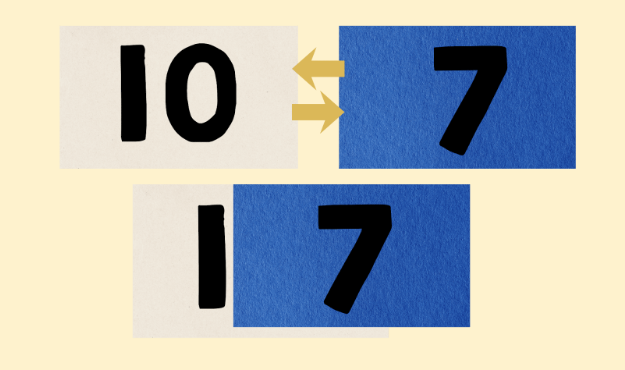
Some early programs like Trailblazers used place value cards where the 7 would cover the 0 in 10, helping students see that 17 hides a 10. Now that’s the kind of visual support that reinforces structure, not just digits. The best tools help kids see tens and ones as quantities, not just positions.
How to Talk About Teen Numbers in Your Classroom
In my book, The Fire & Wire Way: Daily Routines to Systematically Build Number Sense, written with Stacy Eleczko and Valerie Faulkner, we talk about how essential it is for students to understand different forms of a number:
“Another essential part of place value is understanding the different forms of a number… Recognizing that numbers are composed of other numbers paves the way for students to have flexibility in thinking about the value of numbers. 34 isn’t just 34 ones or 3 tens and 4 ones. It’s also 2 tens and 14 ones.”
We reinforce teen number structure with clear language in activities like Double Digit Finger Flash.
Here’s how it works: Students respond by flashing ten fingers for one ten, then additional fingers for the ones. If the teacher holds up 14, students respond with 10 fingers, then 4 more. You can read the whole activity below.

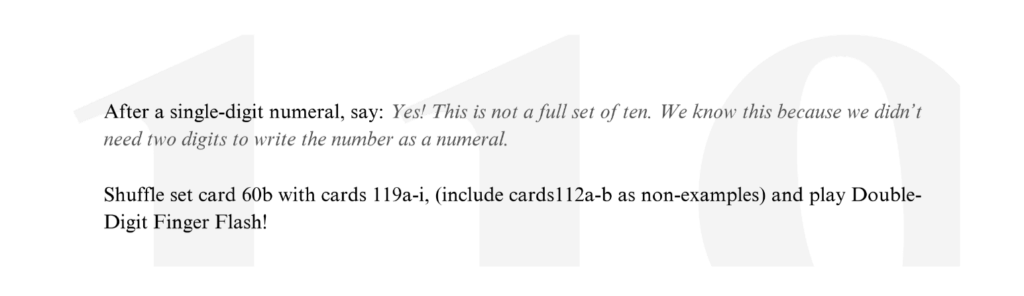
This isn’t a trick. It’s a physical way to show the structure: one ten and some more. It’s also a quick check for understanding that reinforces both language and structure without relying on symbolic representation too early.
Connecting Teen Numbers to Number Composition
If you want to go deeper on this, my blog post, Numbers Are Made of Other Numbers, shows how early activities like “Plates and Forks” and “How Many Bears?” set the stage for number composition. Teen numbers are a natural next step in this thinking.
Teach It Right the First Time
Teen numbers are the gateway to the base ten system. They’re where students first learn that numbers are made of tens and ones, not just digits written side by side. Teach this well, and place value has meaning. Skip it, and students are left memorizing symbols without understanding the system underneath.
