



February 18, 2026
We’ve all said it. “In a minute.” “Just add a zero.” “The bigger half.”
We don’t mean to mislead. But when we oversimplify math language, students end up confused instead of clarified.
This isn’t about being picky. It’s about how the words we use become the foundation for how students understand math.
Math Practice Standard 6 tells us to “attend to precision.” At first glance, that might sound like checking your answers or labeling your units. Yes, accuracy matters, but precision of language is something else entirely. It’s about the clarity and consistency of our communication: how we talk about math, how we model it, and how we support students in describing the relationships they see.
So let’s look more closely at the everyday phrases we use, the structures we lean on, and the models we build. Because when we’re intentional with our language, we’re doing more than cleaning up our vocabulary. We’re making the math more visible, accessible, and meaningful for every learner.
The Words We Use Become the Math Students Know
Let’s start with something simple.
“When you add, the number gets bigger.” “When you subtract, the number gets smaller.”
For students working with whole numbers, this feels true. But what happens when we introduce zero? Or negative numbers?
Suddenly, those neat little definitions don’t hold.
If I have 6 blocks and add zero, I still have 6.
If I take 6 blocks and subtract zero, I still have 6.
And if I subtract –4 from –9, I actually get more than what I started with.
So if we’ve taught students that “subtracting means taking away,” or “subtraction always makes the number smaller,” they don’t just feel surprised, they feel stuck. They think they did something wrong because of the misconceptions we unintentionally created–because the math didn’t follow the “rule.”
And it’s not just about operations. We hear this in all areas of math:
- “Just add a zero” when multiplying by ten
- “Draw a circle” around your answer
- “The bigger half” (as if halves can come in different sizes!)
As educators, we use these phrases to be efficient or supportive. But students often take them literally. They use our language to build their definitions, and when the definitions don’t work anymore, they start to lose trust in the math or in themselves.
“When teachers use conversational or informal language instead of mathematical language, students may get confused.”
— WWC, Assisting Students Struggling with Mathematics
The language we use matters. That means we, as teachers, have to start with ourselves.
Start With Us: Teacher Language Sets the Tone
If we want students to speak and think mathematically, we have to model that first. It’s about being intentional with how we frame questions and prompt students to explain their thinking.
Teachers tell me during PD, “The questions you ask are different. That’s what I want to be able to do.” Honestly, it’s not magic. It’s just being precise.
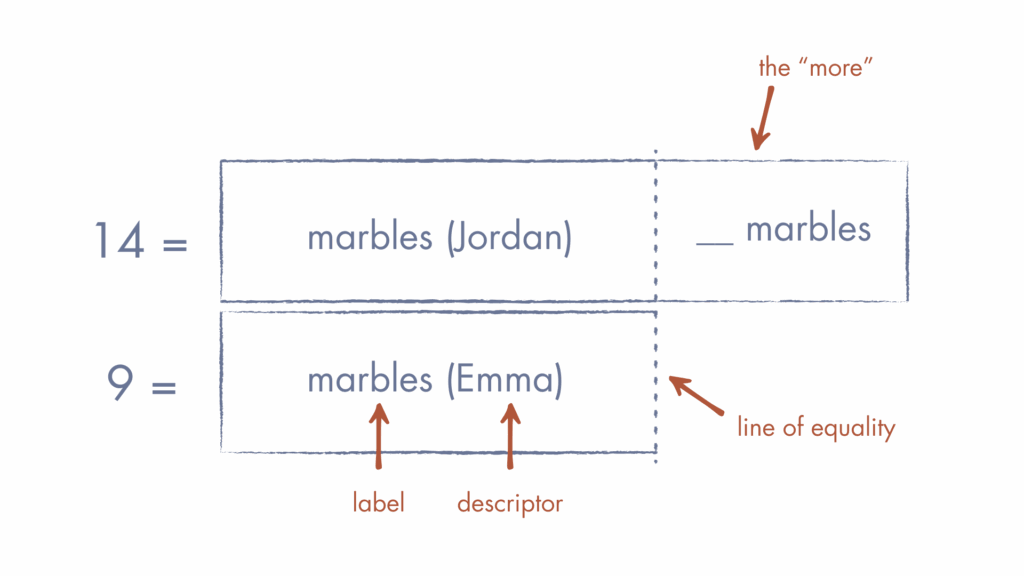
Here’s one I use a lot: “Where is the more on the longer bar?”
Notice what that does. I’m not asking “Which is bigger?” I’m prompting students to look for a relationship. I’m using Compare structure language to highlight the quantities involved and what we’re actually comparing.
That’s one of the biggest shifts with Structures of Equality. We’re not teaching kids to match problems to key words. We’re teaching them to recognize relationships, and the language we use either supports that or gets in the way.
So when we introduce the Compare structure, we don’t just say “How much more?” We clarify: more of what? Compared to which quantity? That clarity helps students make sense of what they’re seeing.
And this isn’t just for “advanced” students. Clear, consistent language supports multilingual learners, students with IEPs, and students who’ve been historically excluded from rich math experiences.
“Use the clear, concise, and correct mathematical language embedded in the standards to build and reinforce students’ understanding.”
— WVDE, High-Quality Mathematical Instructional Practices for Students with IEPs, Dyscalculia, and Mathematics Difficulties
Precision isn’t an intervention. It’s access.
Connecting Symbols to Mathematical Language
Without language to anchor them, students are left guessing at what symbols mean. We can’t assume that because students see a minus sign, they understand what it represents in context.
I still hear subtraction introduced as “take away.” Sometimes that’s accurate, but subtraction can also mean comparing or finding distance on a number line. If we only give students one interpretation, we limit how they see subtraction working.
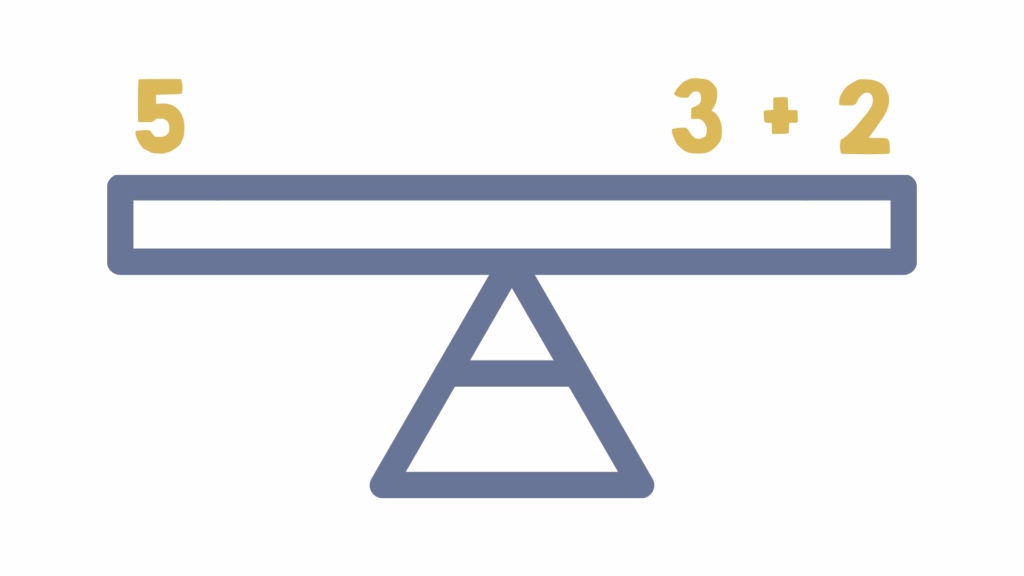
Same with the equal sign. Students often think “=” means “this is where the answer goes.” Here’s the problem: equality isn’t about an answer; it’s about balance. The expressions on both sides represent the same value. If we’re not explicitly saying that and modeling it, we’re reinforcing a narrow view of equations.
This matters especially for students still acquiring academic English. Vocabulary lists won’t get them there. What helps is consistent use: seeing and hearing mathematical terms in context, tied to visual models and real reasoning.
So when we say “5 equals 3 plus 2,” we’re showing a relationship. We’re saying, “These two expressions are equivalent.” When we ask, “What’s the difference between 9 and 5?” we’re not asking them to subtract, we’re asking them to compare, to describe, to model.
Symbols need language. The more precise we are, the more clearly students see the structure underneath the math.
Using Models to Reinforce Precision
Visual models can reinforce clarity or create confusion. If the model doesn’t match the language, students walk away with partial understanding at best.
I’ve caught myself saying “Circle your answer.” But then I think: are we drawing a circle? A ring? Just enclosing the number? That might feel like a small distinction to us, but to a child, especially a Multilingual Learner (MLL) or one still building visual processing skills, it’s not always clear.
So when I use a Compare structure, I’m intentional. I don’t say “Put a circle here.” I’ll say, “In some books, you might see a circle or an oval here. I don’t use that shape because…” and then I explain. Every part of the model means something.
It’s the same with labeling. We’ve talked about this in SoE work before. You don’t label a bar “person”. You label it “shoes (brown)” or “students (wearing red)” . It’s not just about identifying what something is; it’s about representing how it’s functioning in the structure.
When our models align with our words, students start to internalize the structure of the problem. They begin to see that math is a way to represent relationships and the model is a visual version of that relationship.
Math Practice Standard 6: Attend to Precision highlights that precision is reflected not just in language, but also in how students represent mathematics: with diagrams, sketches, and models that align clearly with the underlying relationships.
And when those models are supported by clear language, we give students two access points: what they hear and what they see.
Precision isn’t about being perfect; it’s about being purposeful. When our models and our language work together, students begin to see that math is something they can make sense of.
Precision as Equity
Precision isn’t an advanced strategy or a bonus for students who are already “getting it.” It’s good instruction for every student. “Using precise language also raises individual understanding and conceptualization.” — “4 Ways to Use Precise Language in Mathematics to Illuminate Meaning” (NWEA)
One of the most effective interventions for students struggling in math? More access to high-quality instruction, not watered-down content. That includes consistent, precise language.
“Instructional practices that promote reasoning and sense-making can be used as interventions.” — WWC, Assisting Students Struggling with Mathematics
So we don’t gatekeep strategies like modeling relationships, naming structures, or labeling with clarity. We use them with everyone. That’s what builds access.
Our students are listening. Even when they’re not ready to use precise terms themselves, they’re soaking in the structure of the language. Over time, it becomes part of their thinking.
Precise Language Builds Deep Understanding
Math is about making sense of relationships. Language is one of our most powerful tools for helping students do that.
So when we pause to say “Subtraction doesn’t always mean take away” or “Addition doesn’t always make the number bigger,” we’re not overcomplicating things. We’re laying groundwork for understanding that grows.
When we model Compare problems with intentional language and clear labels, we help students see structure. When we connect symbols to words, we show them that math is a language in itself.
Yes, we’ll slip into “circle your answer” sometimes. But every time we rephrase or clarify, we’re building more accurate definitions, ones that will serve students long after the worksheet is done.
Let’s be mindful of the words we use. Not because we’re trying to be perfect, but because all students deserve math instruction that’s clear, meaningful, and built to last.
