




February 7, 2024
Updated July 22, 2026
In math, units usually come up when we’re teaching measurement. But they show up everywhere, and they matter a lot more than we give them credit for. That’s one of the reasons every structure in SoE has three critical components. They help build the foundation students need to understand units. Here are the three things every structure must include.
- Every structure must include: values (the numbers)
- labels and descriptors (what you’re counting and words that tell us more about each value)
- a clear representation of equality.
When all three are present, we can see comprehension. When something’s missing, that tells us something too.
Why Are Labels and Descriptors a Crucial Element of Every Structure?
Labels and descriptors help us name what we’re counting and give each value meaning in the story. That’s actually what separates a Structure of Equality from a bar model.
A student can draw a bar model without really understanding the story. They can place numbers in boxes and get a correct answer without knowing what any of those numbers actually represent. But they can’t label and describe a structure correctly without conceptually understanding what’s happening. The model forces comprehension into the open.
How Labels Help Students Comprehend: A Bar Model vs SoE Comparison
The example number story:
There are 29 students on the playground. Some more students show up. There are now 47 students.
Notice there’s no question posed. We’ll come back to that.
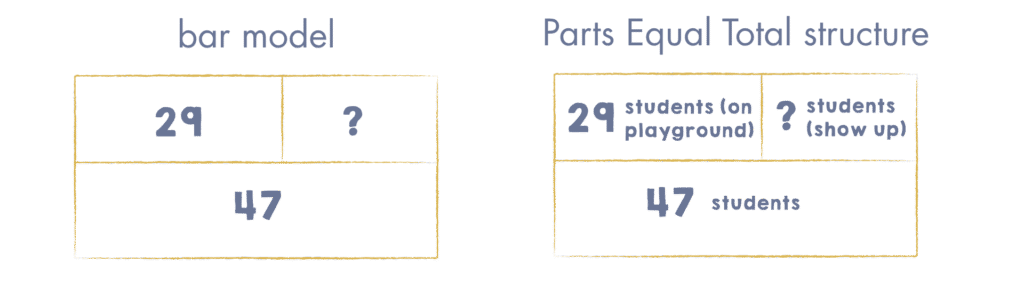
At first glance, both models could look like a student who gets it. But in the bar model, those are just numerals. A student could grab the biggest number and drop it in the biggest bar and still solve it correctly. You’d never know they had no idea what the story was about.
Without conceptually understanding what’s happening in the story, students can produce a correct answer and still be completely lost. That’s one of the most frustrating things teachers tell me about math stories. Students seem fine during a lesson, then fall apart when they try to solve independently. The comprehension gap was there the whole time. It just wasn’t visible.
Here’s what’s interesting about that example. Intentionally, no question was posed. With a complete structure, labels, descriptors, values, and equality, a student can answer any question you attach to that story.
Now let’s think of a few questions that could be posed for this problem:
- How many students showed up on the playground?
- How many more students were on the playground than the number of students that showed up?
- If the students that were originally on the playground went back to class, how many students would be left?
But Do the Labels Really Matter?
If students are getting correct answers anyway, you might wonder whether labels are worth the extra step. They are. Math isn’t just answer-getting. Solving a number story without understanding the context is like reading a book without comprehending what’s happening. The “answer” might be right, but the understanding isn’t there.
What’s the Connection Between Labels and Units?
A label is how we name a unit, and a unit is what gives a number meaning. Without it, 237 is just 237. Inches? Yards? Students? Animals? The numeral doesn’t tell you. The label does. That’s true inside a structure, and it’s true across every strand of mathematics your students will encounter.
Units in Number Stories at the Elementary Level
Take our example from earlier. The label “students” might seem redundant when every value in the story represents students. But if you change the story slightly, it matters immediately.
There are 29 cats at the shelter. Some dogs show up. There are now 47 animals.
Although the structure and values are identical, the context is completely different. Now we’re working with cats, dogs, and animals, three different labels for three different units. A student who isn’t tracking that won’t be able to label the structure correctly. And that’s the tell.
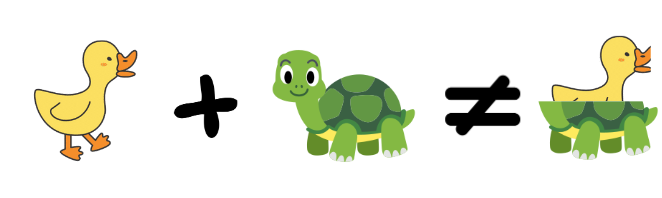
My The Fire & Wire Way co-author, Valerie Faulkner, put it perfectly during a training. If you have 3 turtles and 5 ducks and you add them together, what do you get? Terducks? Duckurtles? To compose those parts into a total, you have to think about what they have in common. They’re both animals.
This gets even more important as students move into multiplicative thinking. With whole number multiplication and division, students are working with a total, a number of groups, and the number in each group. There are three different values with three different labels. If they don’t know what each one represents, they can’t make sense of the story.
When fractions enter the picture, the relationships become more complex. Students aren’t just counting anymore, they’re scaling. Without understanding what the values represent, they can’t visualize what’s happening, let alone reason through it.
How Labeling Units Helps Lay the Foundation for Fractions
If you’ve taught third grade or above, you’ve seen the “deer in the headlights” look. Fractions appear in a number story and students freeze. They’ve worked with whole numbers long enough that fractions feel like a foreign language.
One of the first concepts we introduce with fractions is the unit fraction. It’s sometimes defined as a fraction with a 1 in the numerator, and while that’s technically true, the meaning runs deeper than that.

These are all examples of ¼. But what do they mean? To think about the unit fraction, we have to consider the denominator. Derived from the Latin word “nomen”, denominator means “to name”. It names our unit.
In this case, our denominator is 4, which means our whole has been partitioned into four equal parts. That part is now our unit, which means one of those four parts is our unit fraction. Just like we counted by students or animals, we are counting in fourths.
The tearducks idea helps here too. Whether it’s a number story or a symbolic equation, you need to know what each value means.
For example, let’s consider ⅔ + ¼.

Students who have been taught to think procedurally can find the value of this expression. But that doesn’t mean they understand it.
Students who have been taught conceptually understand the unit fraction. They know that ⅔ is equivalent to ⅓ + ⅓. They know that thirds and fourths are different units, just like turtles and ducks. And they know that in order to make sense of the problem, they need to find a common way to name the unit: a common denominator.
Teaching students to label their units in the context of number stories gives them the foundation to reason through abstract concepts like this. If you want to explore more, check out the examples in “Why the unit of measure matters.”
Units and Labels Beyond Number Stories and Fractions
The understanding of units is one of the most foundational concepts in math. It shows up in unit rate, operations with decimals, powers of ten, proportional relationships, and labeling the x and y coordinates to understand the relationship between dependent and independent variables. When you start to see how far it reaches, it’s hard to unsee.
Where To Start
Building a strong, conceptual understanding of units in early math sets students up across every domain. It’s not just about math stories. But number stories are where we can make it visible, concrete, and meaningful from the start.
Even if you’re not using SoE yet, try asking students to label the values in their work every time. Ask them, “What’s the thing we’re counting?” You might be surprised by what that one question reveals.
